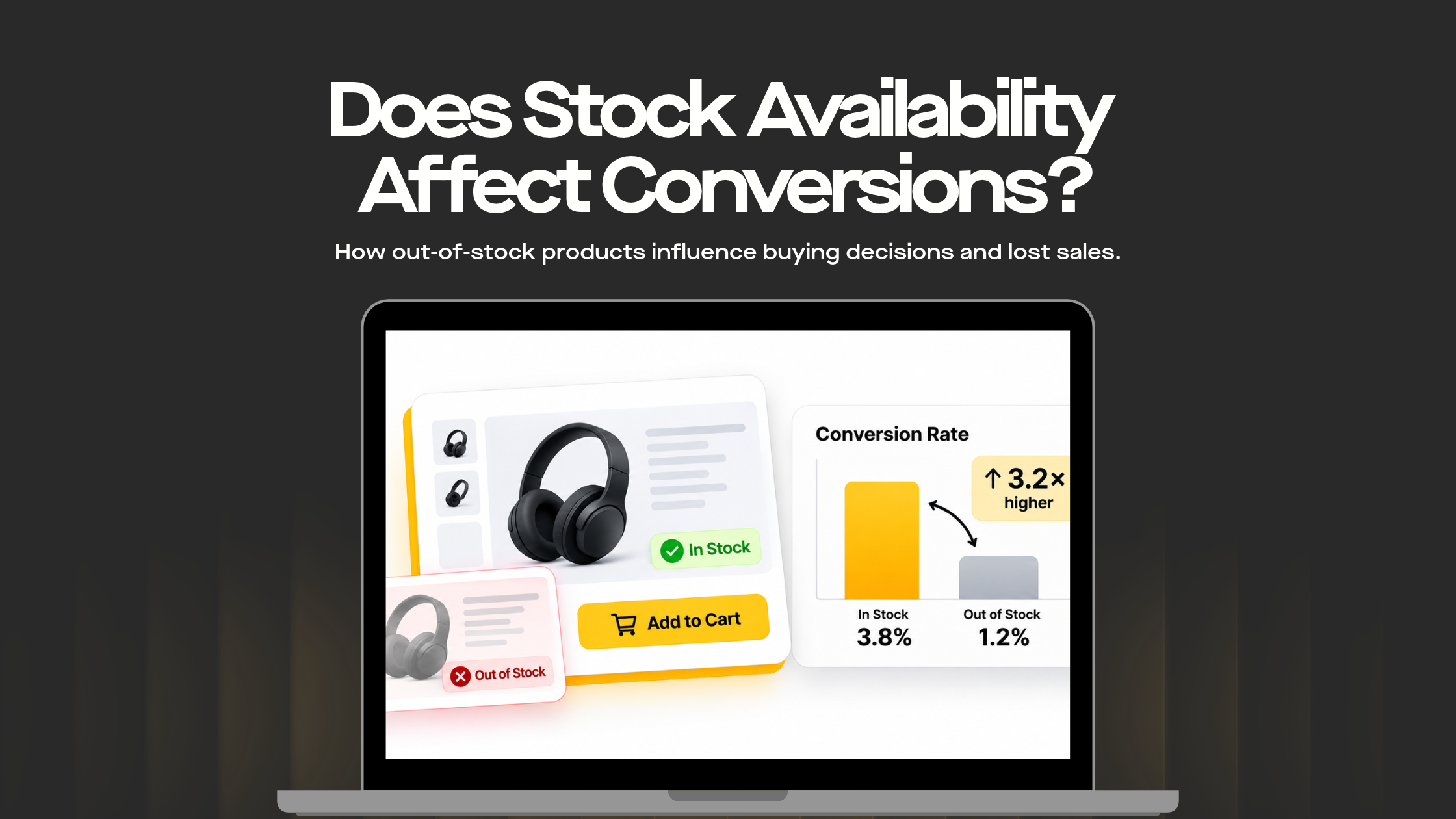
1. Why Stock Availability Belongs in CRO Analysis
Stock is often owned by ecommerce operations or merchandising, while conversion is monitored by digital and marketing teams.
The customer does not see that distinction.
If someone arrives on a product page with the intention of buying a particular item and discovers that their size is unavailable, the failed purchase is still part of the digital customer journey.
That makes availability an important variable when analysing ecommerce performance.
Consider a product receiving 40,000 visits during a promotional period. Its conversion rate is significantly below the site average, so the team identifies the product page as a potential CRO opportunity.
Before changing the page, there is another question worth answering:
Was the product actually available to the customers who were trying to buy it?
If the most popular variants were unavailable for much of that period, changing the layout or call to action may have very little impact.
This is one reason a good Ecommerce analysis needs to look beyond the conversion rate itself.
2. A Product Can Be in Stock and Still Be Unavailable to Customers
A simple stock status can hide what customers are experiencing.
Imagine a retailer selling a popular jacket. The website shows the product as “In stock”, but the most common sizes have sold out.
From an inventory perspective, the product is available.
From the customer’s perspective, it may not be.
The same issue can occur with:
- Clothing sizes
- Shoe sizes
- Colours
- Device configurations
- Furniture finishes
- Product bundles
- Subscription options
This is particularly important for products with a large number of variants.
If a product has 100 units remaining but none of the commonly selected variants are available, the overall stock figure tells you very little about the likelihood of conversion.
That is why product availability sometimes needs to be analysed at variant level.
A useful analysis can compare the availability of the selected variant with what happened afterwards. Did the customer choose another option? Did they add something else to the cart? Did they look at another product? Or did they leave?
Those behaviours help distinguish an availability problem from a broader product or UX problem.
3. How to Tell Whether Stock Is Causing the Conversion Drop
A drop in conversion does not automatically mean that stock is the problem.
You need to look for a relationship between availability and customer behaviour.
Start with products that have meaningful traffic, revenue or marketing investment.
Then compare performance when products were fully available with periods when availability was restricted.
Useful measures include:
- Product views
- Variant selection
- Add-to-cart rate
- Checkout starts
- Purchase rate
- Revenue per visitor
- Product exits
- Alternative product views
- Refunds and cancellations
The timing matters as well.
If conversion was stable while a product was fully available and fell soon after its popular variants sold out, that is useful evidence.
It does not prove that stock caused the entire decline, but it gives the team a clear reason to investigate further.
You can then segment the analysis by traffic source, device, customer type and product variant to see whether the pattern is consistent.
This is much more useful than looking at the overall ecommerce conversion rate and assuming the website needs a redesign.
4. What Customer Behaviour Tells You When Stock Becomes Limited
The most useful evidence often comes from what customers do after they encounter an availability problem.
Suppose a customer selects a size that is unavailable.
There are several possible outcomes.
They might select another size and continue. They might look at a similar product. They might search for another product in the same category. They might add a different item to their cart. Or they might leave the website altogether.
Each outcome tells you something different.
If customers regularly move to suitable alternatives and continue purchasing, the website may already be recovering some of the lost demand.
If customers leave immediately, there may be an opportunity to improve the experience around unavailable products.
This is where behavioural data becomes particularly useful.
Session recordings, funnel analysis, site search data and product-level analytics can help explain what happens after availability changes.
The objective is not simply to prove that stock affects conversion. It is to understand how customers respond when their first choice is unavailable.
That gives the CRO team something actionable to work with.
5. Analyse Stock Availability Alongside the Conversion Funnel
A product conversion rate on its own cannot tell you where the problem sits.
Consider a product that receives strong traffic but has a low purchase rate.
If customers are not adding it to their carts, the issue could be product relevance, pricing, product information or availability.
If add-to-cart rates are healthy but purchases are low, the problem may be further down the journey.
That could include delivery costs, payment options, checkout friction or another issue that has nothing to do with stock.
This is why availability should be analysed alongside the broader funnel.
ObservationWhat it may indicateHigh product views, low add-to-cartProduct, price, relevance or availability issueHigh add-to-cart, low checkout completionCheckout or purchase frictionPopular variants frequently unavailableInventory or merchandising issueCustomers view alternatives after stockoutsPotential recovery opportunityCustomers leave after unavailable variant selectionWeak recovery experienceConversion returns when stock is replenishedStronger evidence of an availability effect
These are not automatic diagnoses.
They are signals that help determine where to investigate next.
That distinction is important in CRO. The purpose of the analysis is to reduce uncertainty before deciding what to change.
6. What Should You Do When Customers Cannot Buy Their First Choice?
An unavailable product does not necessarily mean the customer journey has to end.
The appropriate response depends on the product and how long it is expected to remain unavailable.
For a product expected back in stock shortly, a back-in-stock notification may be enough.
For a product that will not return for several months, the website may need to help the customer find an alternative.
Possible approaches include:
- Showing relevant alternatives
- Offering back-in-stock notifications
- Providing expected replenishment information
- Showing store availability
- Recommending similar products
- Improving variant selection
- Making availability information clearer
The important point is relevance.
Showing a random best-selling product because the original item is unavailable is unlikely to solve the customer’s problem.
A better recommendation is one that reflects what the customer was actually trying to buy.
This is where personalisation can support CRO, provided the recommendation is based on a genuine customer need rather than simply adding another feature to the page.
7. When Stock Problems Are Actually Marketing Problems
Stock availability can also affect the performance of marketing campaigns.
Imagine a paid campaign is sending significant traffic to a product whose most popular variants are unavailable.
The advertising platform may report healthy traffic and engagement, but the ecommerce team sees weak conversion.
The initial response might be to optimise the campaign.
There is another option: check whether the campaign should still be sending customers to that product.
Depending on the data, the business might be better off:
- Promoting products with stronger availability
- Changing the landing page
- Adjusting product feeds
- Reducing spend on affected products
- Promoting suitable alternatives
- Changing the offer
This is where analytics becomes commercially useful.
The question is no longer simply, “Why is this campaign not converting?”
It becomes:
“Are we sending customers to products that can actually satisfy the demand we are creating?”
That is a much stronger decision for a digital or ecommerce team to make.
8. How to Prioritise Stock-Related CRO Opportunities
Not every stock issue deserves the same level of attention.
A product with limited traffic and low revenue potential is unlikely to be the first place to invest CRO resources.
A high-volume product receiving significant paid traffic is different.
A practical prioritisation should consider four things.
8.1 How Much Demand Is Affected?
Look at the number of customers encountering the availability problem rather than simply counting unavailable products.
8.2 What Is the Commercial Value?
Consider revenue, average order value, product margin and the potential value of the affected traffic.
8.3 What Are Customers Doing Instead?
If customers readily move to alternatives, the revenue impact may be smaller.
If they leave the website, the opportunity becomes more significant.
8.4 What Can Actually Be Changed?
The appropriate intervention could sit with CRO, merchandising, marketing, inventory management or technology.
This prevents the CRO team from treating every problem as a website testing opportunity.
9. What Should You Measure in Ecommerce Analytics?
Stock availability should be included in ecommerce reporting for important products and categories, particularly during periods of high demand.
A useful view can combine availability with customer and commercial metrics.
MetricWhat it helps you understandStock availabilityWhether customers can purchaseVariant availabilityWhether popular options are availableProduct viewsLevel of customer demandAdd-to-cart rateStrength of purchase intentCheckout startsProgression towards purchaseConversion rateCompleted purchasesRevenue per visitorCommercial value of trafficAlternative product viewsWhether customers recoverCart abandonmentPotential downstream frictionRefunds and cancellationsPotential fulfilment impact
The value comes from connecting the measures.
A report showing only Ecommerce CR can tell you that conversion changed.
Connecting conversion with product availability can help explain why.
That distinction is particularly important when deciding whether to run an experiment.
10. When Should You Test, Fix or Leave the Problem Alone?
Once the analysis shows that availability is contributing to a conversion problem, the next step is not automatically an A/B test.
The right response depends on what the evidence shows.
Or the emphasis might be on better inventory visibility or merchandising if customers can’t find the variant they want to buy.
If customers can buy the product but have difficulty understanding availability, it may be worth testing clearer messaging.
If people are leaving your site due to products being out of stock, you might want to explore alternative recommendations or back-in-stock functionality.
Good inventory, but your conversion is low? The problem may be elsewhere in the journey.
That could mean looking at product information, pricing, traffic quality, mobile experience or checkout.
This is where a CRO Agency or CRO team should add value: not by creating tests for the sake of testing, but by identifying the most likely source of friction and helping the business decide what evidence is needed before making a change.
Good CRO Consulting should make the decision clearer, not simply produce a longer list of experiments.
11. Final Thoughts
Stock availability is easy to classify as an operations issue because inventory is usually managed outside the digital team.
For the customer, there is no such separation.
They see a product, decide whether they want it and then try to buy it. If their preferred size, colour or configuration is unavailable, the customer journey changes immediately.
That makes availability an important part of ecommerce CRO and analytics.
When conversion falls, do not stop at the conversion rate. Look at what customers were trying to buy, whether the relevant products and variants were available, what happened when they encountered a stock problem and whether they found a suitable alternative.
Then connect that behaviour with revenue and marketing performance.
The solution may be a UX change, better stock messaging, stronger product recommendations or a change in merchandising. In some cases, the most commercially sensible decision may be to stop sending high-intent traffic towards products that cannot meet demand.
The important thing is to make that decision from evidence.
That is where ecommerce analytics and CRO work best together: analytics helps explain what is happening, while CRO helps determine what the business should do about it.