Australia’s CRO Agency
You’re getting traffic
But The problem is visitors aren’t converting.
More traffic won’t solve a conversion problem. We identify where customers hesitate, abandon, or lose trust, then improve those moments through structured experimentation.


Built for brands already investing in growth.


What happens when you
stop guessing and start experimenting?
Real ecommerce optimisation decisions based on user behaviour and conversion psychology.

Weak Product Visibility
Important buying information was buried too low on the page, making users work harder to understand the product.

Delayed Purchase Intent
Product title, trust signals, reviews, and sizing information appeared too late in the customer journey.

Passive Content Hierarchy
Large lifestyle imagery dominated the experience while key conversion elements lacked visibility and structure.

Limited Trust Reinforcement
Shipping, returns, and reassurance signals were disconnected from the purchase decision and easy to miss.

Friction Across Mobile UX
The product page lacked clear scanning behaviour, creating hesitation across mobile interactions and product discovery.

Earlier Decision-Making Signals
Product relevance, urgency, reviews, and product clarity introduced immediately above the fold.

Improved Information Hierarchy
Product details, sizing, variants, and trust elements reorganised into a clearer conversion-focused structure.

Reduced Visual Friction
Content sections simplified to improve scanning behaviour and reduce cognitive overload across mobile devices.

Stronger Trust Placement
Returns, shipping, and reassurance messaging positioned closer to high-intent conversion actions.

Conversion-Focused PDP Experience
Every layout adjustment was designed to improve usability, reduce hesitation, and strengthen purchase confidence.
CRO focused on
measurable growth.
Conversion-focused services designed to reduce friction, improve user experience and turn more visitors into customers.

A/B Testing
We replace assumptions with structured experimentation designed to improve conversion performance. Our A/B and multivariate tests explore messaging, layouts, pricing, forms, and user flows to identify what drives stronger engagement, fewer conversions, improved usability, and better customer decision making across important touchpoints.

Website Personalisation
Personalised experiences improve engagement by making content more relevant to individual visitors and customer segments. Using behavioural signals, audience segmentation, and previous interactions, we tailor messaging, recommendations, and on-site experiences to improve trust, engagement, and overall conversion performance.

CRO Audit
A CRO audit helps uncover what’s reducing conversions across your website or landing pages. We review user journeys, calls-to-action, page structure, behavioural patterns, and user interaction points to identify friction, missed opportunities, and areas negatively impacting overall conversion performance and usability.

End-to-End CRO
For brands investing heavily in acquisition, conversion performance management becomes the growth lever that matters most. Our CRO consultants manage the full optimisation process — from behavioural analysis and experimentation through to reporting, refinement, and scaling improvements across the customer journey and overall user experience.

Heatmap Analysis
Heatmap analysis reveals how users interact with your website across important conversion pages and user journeys. We analyse clicks, scroll behaviour, and attention patterns to identify overlooked content, weak engagement areas, usability issues, and opportunities to improve layout visibility and interaction performance.

E-commerce Sales Optimisation
Small points of friction throughout the buying journey can significantly reduce e-commerce revenue and conversion performance. We analyse the full customer experience to improve usability, reduce abandonment, strengthen checkout performance, and increase overall conversion efficiency across the e-commerce sales funnel.

UX/UI Design
Poor usability creates hesitation and increases customer drop-off across important conversion journeys and landing pages. We design cleaner, more intuitive digital experiences that improve navigation, strengthen visual clarity, and help users complete actions with less friction across devices and screen sizes.
Our service from Tapan and the DigitXL team has been outstanding. Very professional and respectful service and treatment of our team while managing expectations of executive management and providing genuine, research based feedback and results and coaching for the whole team.

Digitxl's consulting in Adobe Analytics reporting and playbook designs has been invaluable. Truly appreciate the expertise and hands-on approach!

Our ecommerce team has greatly benefited with the engagement with Digitxl team. They have tagged our website with right Google Analytics events, enabling detailed analysis on our users car abandonment rates. The Data Studio dashboard has really simplified the reporting process, proving timely insights to entire team.

We recently engaged the Digitxl team to measure our ecommerce funnels and marketing campaigns, extracting all the data into data studio dashboard. It has helped us to see how we are tracking and where we need to optimise our marketing efforts.

Our DIGITXL consultant has helped us to automate our Adobe Analytics & datalayer implementation by working with our DevOps teams. Data quality has improved dramatically with our new event-based datalayer, helping us to build trust in our data & confidently share the insights with our teams.

Our ecommerce team has greatly benefited with the engagement with Digitxl team. They have tagged our website with right Google Analytics events, enabling detailed analysis on our users car abandonment rates. We are really happy with the consultation and prompt support provided by the team.
I highly recommend DIGITXL for their outstanding analytics expertise, strategic thinking, and dedication to meeting customer requirements. Tapan and his team at DIGITXL have a comprehensive approach that aligns with business/campaign objectives.

Our CRO Process

Phase A
Instrumentation & Baseline
What We Do
- Analytics validation & gap analysis
- Event taxonomy design
- Funnel visibility setup
- Baseline metric benchmarking
What You Get
- Measurement audit report
- Event tracking plan
- Baseline dashboard
What Improves
- Trustworthy data foundation
- Clear funnel visibility
- Accurate conversion tracking

Phase B
Insights & Research
What We Do
- Quantitative analysis (GA4, heatmaps)
- Qualitative research (surveys, recordings)
- Usability testing
- Competitive benchmarking
What You Get
- CRO opportunity map
- User behaviour report
- Prioritised insight deck
What Improves
- Evidence-based hypotheses
- Clear friction points identified
- Revenue opportunity sizing

Phase C
Experiment Design
What We Do
- Hypothesis formulation (ICE/PXL)
- Variant wireframing
- Sample size calculation
- QA plan & guardrail definition
What You Get
- Experiment brief
- Variant mockups
- Test plan with guardrails
What Improves
- Rigorous test design
- Clear success criteria
- Risk mitigation built in

Phase D
Build & Launch
What We Do
- Variant design & development
- A/B tool configuration
- Targeting & segmentation
- Pre-launch QA checklist
What You Get
- Live experiment
- QA sign-off
- Monitoring dashboard
What Improves
- Clean test execution
- Zero implementation errors
- Real-time monitoring

Phase E
Analyse & Learn
What We Do
- Statistical significance analysis
- Segment-level deep dive
- Business impact modelling
- Learning documentation
What You Get
- Experiment report
- Segment analysis
- Revenue impact estimate
What Improves
- Actionable learnings
- Clear winner identification
- Compound knowledge base

Phase F
Scale Winners
What We Do
- Winner rollout to 100% traffic
- Implementation documentation
- Backlog refresh & re-prioritisation
- Regression monitoring
What You Get
- Rollout confirmation
- Implementation spec
- Updated experiment backlog
What Improves
- Revenue captured permanently
- Zero regression risk
- Continuous improvement cycle
Phase A
Instrumentation & Baseline
What We Do
- Analytics validation & gap analysis
- Event taxonomy design
- Funnel visibility setup
- Baseline metric benchmarking
What You Get
- Measurement audit report
- Event tracking plan
- Baseline dashboard
What Improves
- Trustworthy data foundation
- Clear funnel visibility
- Accurate conversion tracking
Phase B
Insights & Research
What We Do
- Quantitative analysis (GA4, heatmaps)
- Qualitative research (surveys, recordings)
- Usability testing
- Competitive benchmarking
What You Get
- CRO opportunity map
- User behaviour report
- Prioritised insight deck
What Improves
- Evidence-based hypotheses
- Clear friction points identified
- Revenue opportunity sizing
Phase C
Experiment Design
What We Do
- Hypothesis formulation (ICE/PXL)
- Variant wireframing
- Sample size calculation
- QA plan & guardrail definition
What You Get
- Experiment brief
- Variant mockups
- Test plan with guardrails
What Improves
- Rigorous test design
- Clear success criteria
- Risk mitigation built in
Phase D
Build & Launch
What We Do
- Variant design & development
- A/B tool configuration
- Targeting & segmentation
- Pre-launch QA checklist
What You Get
- Live experiment
- QA sign-off
- Monitoring dashboard
What Improves
- Clean test execution
- Zero implementation errors
- Real-time monitoring
Phase E
Analyse & Learn
What We Do
- Statistical significance analysis
- Segment-level deep dive
- Business impact modelling
- Learning documentation
What You Get
- Experiment report
- Segment analysis
- Revenue impact estimate
What Improves
- Actionable learnings
- Clear winner identification
- Compound knowledge base
Phase F
Scale Winners
What We Do
- Winner rollout to 100% traffic
- Implementation documentation
- Backlog refresh & re-prioritisation
- Regression monitoring
What You Get
- Rollout confirmation
- Implementation spec
- Updated experiment backlog
What Improves
- Revenue captured permanently
- Zero regression risk
- Continuous improvement cycle


2.6x
Achieved through analytics-led CRO & experimentation.
100+
Across ecommerce, lead generation and digital customer journeys.
$27m+
Measured across revenue uplift, cost reduction and marketing performance.
70%
Turning analytics and CRO findings into implemented improvements.
15+
In analytics, CRO, and martech consulting


Real stories Real numbers.

ECOMMERCE · TEELIXIR
1.1% → 3.5%
Shopify conversion rate uplift through behavioural targeting, A/B testing, and checkout funnel optimisation.

ENERGY · ENERGY AUSTRALIA
$500K Saved
Automated Adobe Analytics tagging eliminated manual development cycles, dramatically improving data quality.

FINANCE · SUNCORP
AAMI & GIO Funnels
Full measurement strategy and playbooks for two major insurance brands, delivering first-class analytics across both funnels.

ECOMMERCE · ON TRACK MEALS
28% Conversion Uplift
Automated Adobe Analytics tagging eliminated manual development cycles, dramatically improving data quality.

FINANCE · LATITUDE FINANCIAL
Data Confidence
Full measurement strategy and playbooks for two major insurance brands, delivering first-class analytics across both funnels.
ECOMMERCE · TEELIXIR
1.1% → 3.5%
Shopify conversion rate uplift through behavioural targeting, A/B testing, and checkout funnel optimisation.

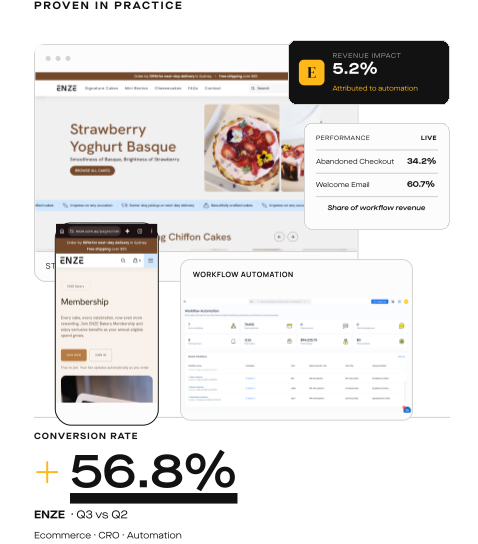
ECOMMERCE · ENZE
2.5× Conversion Rate
A loyalty-led growth strategy combining customer behaviour data, personalised offers and CRO improvements increased conversion from 2.2% to 5.5% while strengthening repeat-revenue opportunities.
ECOMMERCE · ON TRACK MEALS
28% Conversion Uplift
Automated Adobe Analytics tagging eliminated manual development cycles, dramatically improving data quality.
FINANCE · SUNCORP
AAMI & GIO Funnels
Full measurement strategy and playbooks for two major insurance brands, delivering first-class analytics across both funnels.
ENERGY · ENERGY AUSTRALIA
$500K Saved
Automated Adobe Analytics tagging eliminated manual development cycles, dramatically improving data quality.

CHARITY · HEART FOUNDATION
Campaign Clarity
Analytics expertise and strategic thinking helped align measurement with business and campaign objectives, giving the team clearer direction across digital performance.

Let’s Calculate Your Website Conversion Rate
We Promise, Your Mind will take it positively. And will help us to figure it out your dreams.
We've heard every objection. Here are the honest answers.
What does a CRO agency do?
A CRO agency helps businesses improve the percentage of website visitors who complete a valuable action, such as buying a product, submitting an enquiry, booking a call, signing up, or requesting a quote.
This usually involves reviewing analytics data, studying customer behaviour, identifying friction points, and testing improvements across key website journeys. A CRO agency may work on landing pages, product pages, forms, checkout flows, navigation, messaging, calls to action and mobile experiences.
Why should I hire a conversion rate optimisation agency?
You should hire a conversion rate optimisation agency if your website is getting traffic but not generating enough leads, sales or revenue.
Many businesses spend heavily on SEO, Google Ads, Meta Ads, email and other acquisition channels, but lose potential customers because the website journey is unclear, difficult or not persuasive enough. CRO helps improve how well your existing traffic converts, rather than relying only on more advertising spend.
What services are included in conversion rate optimisation?
Conversion rate optimisation services usually include a mix of research, analytics, UX review, testing and implementation support.
Common CRO services include:
| CRO Service | What It Helps With |
| CRO audit | Identifies conversion barriers and priority improvements |
| Funnel analysis | Shows where users drop off in the journey |
| A/B testing | Compares different page or journey variations |
| Heatmap analysis | Shows where users click, scroll and engage |
| Session recordings | Helps understand real user behaviour |
| Landing page optimisation | Improves clarity, relevance and action-taking |
| Product page optimisation | Improves ecommerce product engagement and buying confidence |
| Checkout optimisation | Reduces friction before purchase completion |
| Form optimisation | Improves enquiry, quote, booking and sign-up completion |
| Personalisation | Adapts content or experiences for different user segments |
The right mix depends on your website, traffic levels, business model and conversion goals.
Can CRO improve ecommerce conversion rates?
Yes. CRO can help ecommerce businesses improve conversion rates by making the shopping experience clearer, easier and more persuasive.
This may include improving product page content, product imagery, reviews, delivery information, pricing clarity, trust signals, cart experience, payment options and checkout usability. For platforms such as Shopify, WooCommerce or Adobe Commerce, CRO can help identify where customers hesitate or abandon the journey.
Why is my ecommerce website getting traffic but not sales?
Your ecommerce website may be getting traffic but not sales because visitors are not finding enough clarity, confidence or motivation to complete a purchase.
Common issues include unclear product descriptions, weak trust signals, limited customer reviews, poor mobile experience, confusing navigation, slow page speed, unexpected shipping costs, limited payment options or checkout friction. CRO helps identify these issues using data and customer behaviour insights, then prioritises what should be improved first.
What is the first step in assessing my site's CRO needs?
The first step involves a comprehensive audit of your website, where we assess current performance, user pathways, and existing conversion barriers. This audit enables us to develop a tailored strategy that directly addresses your site’s unique challenges.
Is CRO only for ecommerce websites?
No. CRO is useful for ecommerce websites, service businesses, B2B companies, SaaS platforms, finance brands, education providers, healthcare businesses and professional services.
For ecommerce, CRO often focuses on purchases, cart abandonment and checkout completion. For lead generation websites, CRO may focus on enquiry forms, quote requests, demo bookings, phone calls, consultation requests, downloads or sign-ups.
What gets tested during conversion rate optimisation?
CRO testing depends on your website goals, audience behaviour and where users are dropping off.
Common test areas include:
| Website Area | What May Be Tested |
| Headlines | Clarity, relevance and value proposition |
| Calls to action | Wording, placement, visibility and intent |
| Landing pages | Page structure, proof points, offer clarity and content flow |
| Product pages | Images, descriptions, reviews, delivery information and pricing layout |
| Forms | Field length, labels, steps, validation and error messages |
| Checkout | Guest checkout, payment options, shipping clarity and trust signals |
| Navigation | Menu structure, category labels, filtering and site search |
| Mobile experience | Page layout, speed, readability and ease of action |
Testing should be based on analytics and user behaviour, not personal preference.
Can CRO reduce cart abandonment?
Yes. CRO can reduce cart abandonment by improving the cart and checkout experience.
This may involve simplifying checkout steps, making shipping costs clearer, adding trust signals, improving payment options, reducing unnecessary form fields, fixing mobile usability issues and making return or delivery information easier to find. These improvements help remove hesitation before purchase.
Can CRO improve return on ad spend?
Yes. CRO can improve return on ad spend by helping more paid visitors convert after they arrive on your website.
If your advertising campaigns are generating traffic but not enough leads or sales, the issue may sit within the landing page, product page, enquiry form or checkout journey. CRO helps improve these areas so your media spend works harder.
How long does conversion rate optimisation take?
CRO is usually an ongoing process. A CRO audit can identify opportunities quickly, but meaningful performance improvement often comes from structured testing, implementation and continuous refinement.
The timeline depends on your website traffic, conversion volume, testing setup, technical complexity and how quickly your team can implement changes. Higher-traffic websites may be able to run tests faster, while lower-traffic websites may need a more research-led optimisation approach.
How much do CRO services cost?
CRO service costs depend on website complexity, traffic volume, testing requirements, analytics setup, business goals and the level of support required.
Some businesses start with a one-off CRO audit to understand the biggest conversion barriers. Others need ongoing CRO consulting, experimentation, UX review, analytics support and reporting as part of a longer-term optimisation programme.
What data is used in CRO?
CRO uses both quantitative and qualitative data to understand how users behave and where they struggle.
This may include Google Analytics data, funnel reports, conversion events, heatmaps, session recordings, form analytics, page speed insights, campaign performance, customer feedback, customer support themes and website usability review. Using multiple data sources helps avoid decisions based on assumptions alone.
Do I need A/B testing for CRO?
Not always. A/B testing is valuable when there is enough traffic and conversion volume to produce reliable results, but it is not the only part of CRO.
For lower-traffic websites, CRO may focus more on analytics review, UX improvements, customer research, technical fixes, landing page improvements and best-practice changes. The right approach depends on your traffic, risk level and business goals.
Does Digitxl support ecommerce CRO?
Yes. Digitxl supports ecommerce CRO across platforms including Shopify, WooCommerce and Adobe Commerce.
Our ecommerce CRO work may include product page analysis, checkout review, cart abandonment analysis, landing page optimisation, customer journey review, analytics validation, A/B testing and performance reporting. The aim is to help ecommerce businesses improve conversion rates and revenue from existing traffic.
Why choose Digitxl as your CRO agency in Australia?
Digitxl combines conversion rate optimisation, digital analytics, experimentation, UX review and Martech consulting to help businesses improve website performance.
Our approach is not limited to surface-level design changes. We look at how users behave, where the journey breaks down, whether tracking is reliable, and which improvements are most likely to support better leads, sales, revenue or customer experience. This makes CRO more practical, measurable and connected to business outcomes.
CRO
MORE CONVERSIONS
Ready to convert more visitors?
Find and fix the friction costing you customers.
Dive into the Latest CRO Insights
15 Best CRO Tools for Australian Businesses: A Practical 2026 Comparison
Choosing the right CRO tool can make conversion improvement easier. Choosing the wrong one can add cost, complexity and reporting……
Mobile App CRO Guide: From User Drop-Offs to Better Conversion
Many app teams think they have an acquisition problem when they actually have a conversion problem. They spend more on……
AI Overviews Are Changing SEO Reports: What Should You Track Now
An SEO report that only shows rankings, clicks and CTR can now miss a large part of the search journey.……
CRO Adelaide: How Local Businesses Can Find Conversion Friction Before Spending More on Ads
Many Adelaide businesses try to grow by increasing ad spend. More Google Ads, more Meta campaigns, more promotions and more……

Why Your Mobile Traffic Doesn’t Convert (And Why Mobile Users Often Leave Without Buying)
Many ecommerce businesses assume poor mobile sales come down to one explanation: mobile users simply browse more and buy less.……

In their own words.
We’ve been incredibly impressed with the DigitXL team. From our very first interaction, it was clear they are passionate about helping their clients succeed. The level of effort they put into auditing our assets, identifying opportunities, and presenting tailored, practical solutions was outstanding. Their approach was thorough, strategic, and thoughtful from start to finish. We’re incredibly glad we found DigitXL and would highly recommend them to anyone looking for a trusted analytics and CRO partner.

Abbey Cubit
Media Strategist
Our Digitxl consultant has helped us to automate our Adobe Analytics & datalayer implementation by working with our DevOps teams. Data quality has improved dramatically with our new event-based datalayer, helping us to build trust in our data & confidently share the insights with our teams.

Damanpreet Kaur
Digital Analytics Lead
I highly recommend DIGITXL for their outstanding analytics expertise, strategic thinking, and dedication to meeting customer requirements. Tapan and his team at DIGITXL have a comprehensive approach that aligns with business/campaign objectives.

Yannick Pierre
Head of Digital
Digitxl’s consulting in Adobe Analytics reporting and playbook designs has been invaluable. Truly appreciate the expertise and hands-on approach!

Sakshi Sukhla
Digital Analytics Lead
Digitxl team has done a fantastic job of managing and organising all our data inputs which have greatly improved our marketing efforts. In a short time, we will be able to offer even greater personalized messaging to our customers which will improve conversions. Our consultant is a great communicator and is very concise with his work. I would highly recommend the Digitxl team. We will continue to work with them in the future.
Daniel W
Co-Founder
We recently engaged the Digitxl team to measure our ecommerce funnels and marketing campaigns, extracting all the data into data studio dashboard. It has helped us to see how we are tracking and where we need to optimise our marketing efforts. While there is still plenty to do, I am confident that we are now on the right path with the help of Digitxl. I would recommend them to any business who are looking to gain visibility of their digital marketing performance and improve their online presence.

Nithiya B
Marketing Manager
Trusted by