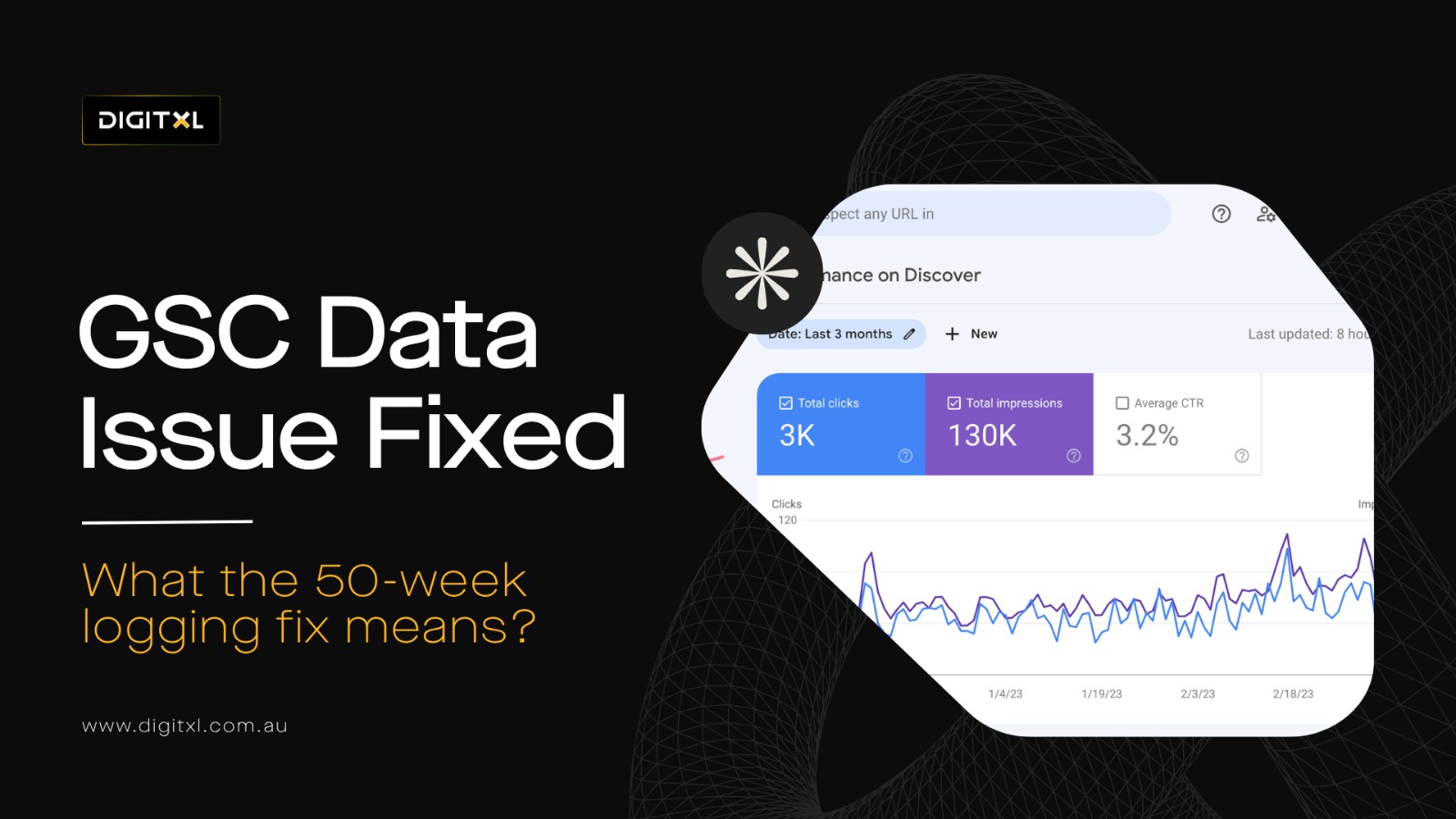
1. Google Search Console Fixed The 50 Week Data Logging Issue
For years, Google Search Console came with a frustrating limitation.
Historical reporting beyond approximately:
50 weeks
lacked continuity.
For SEO teams responsible for understanding:
- Long-term SEO performance
- Search trends
- Keyword opportunity shifts
- Seasonal traffic behaviour
- Search engine results pages (SERPs) performance
- Content performance analysis
this created friction.
Many teams rely heavily on the Google Search Console Performance Report to understand:
- Search results visibility
- Search queries
- Impression drop patterns
- Website impressions
- Click-through rate
- Average position
Yet historical continuity often lacked reliability.
This meant businesses attempting YoY comparisons frequently worked with incomplete historical context. For organisations building:
- Reporting dashboards
- SEO reporting frameworks
- Executive SEO reports
- Performance benchmarks
this created uncertainty. Especially when stakeholders asked:
Why did traffic decline?
Because SEO reporting without historical consistency often creates measurement gaps rather than clarity.
2. Why This Matters More Than It Sounds
Many businesses treat Search Console as the source of truth for SEO. That assumption deserves caution. Search Console is powerful. But incomplete.
It explains:
visibility inside Google Search
not complete business performance.
This distinction matters. Because visibility and business outcomes are not the same thing.
For example:
A page may gain impressions while losing engagement or rankings may improve while conversion performance weakens.
This is why strong reporting teams increasingly combine:
- Google Search Console
- Google Analytics
- Google Analytics 4
- Server logs
- Reporting tools
- Third-party tools
- SEO platforms
to understand:
what happened before and after the click
Search Console helps answer:
What happened in search?
Analytics helps answer:
What happened after users arrived?
This becomes increasingly important as search surfaces continue expanding through:
- AI Overviews
- Google Images
- Knowledge Graph experiences
- AI-generated recommendations
because traditional SEO metrics alone increasingly tell:
an incomplete story.
3. Why Some Traffic Drops May Have Been Misunderstood
Many marketers have experienced this scenario Traffic declines Stakeholders ask questions and SEO teams begin investigating:
- Technical SEO issues
- Indexing issues
- Website structure problems
- Weak backlink profile growth
- Meta descriptions
- Header tags
- On-page edits
- Content optimisation issues
In some cases, teams assume:
Google changed the rules again
through another ranking update or algorithm update.
However, historical reporting limitations sometimes made comparisons more difficult than expected.
For example:
An ecommerce business comparing March this year vs March last year may have struggled with incomplete visibility into:
- Search queries
- Impression counts
- Keyword opportunities
- Search engine visibility
- Organic traffic patterns
This matters because many industries experience natural seasonality.
Especially:
- Ecommerce
- Education
- Finance
- Travel
- B2B SaaS
Without stronger measurement baselines teams often confuse seasonal shifts with SEO decline.
The result?
- Poorer decision-making.
- Unnecessary concern.
And occasionally:
solving problems that may not actually exist.
4. Why This Changes SEO Reporting Conversations
SEO teams already face a difficult challenge:
proving long-term business impact.
Paid channels often feel easier as Google Ads provides:
- Spend visibility
- Cost tracking
- Faster attribution
SEO works differently. Strong search engine optimisation relies on:
- Historical context
- Content Quality
- Content Updates
- White-hat SEO practices
- Technical SEO improvements
- Link building consistency
This is where the data logging issue created friction. Because many reporting teams rely on historical data to answer:
- Did rankings improve?
- Did CTR decline?
- Did average position shift?
- Did AI Overviews affect visibility?
- Did website impressions drop?
- Was organic visibility impacted?
Without historical continuity, reporting confidence weakens.
This becomes especially difficult for:
- SEO managers
- Marketing managers
- Report makers
- Analytics teams
- Digital marketing leaders
who need to explain performance clearly.
5. Why AI Search Makes Reporting Harder
SEO reporting is already changing. The rise of AI-first SEO means businesses increasingly need to measure visibility differently.
Traditional SEO reporting focused heavily on:
- Rankings
- Search results
- Clicks
- Organic search engine listings
Increasingly, brands must also consider:
- AI answers
- AI recommendation sets
- AI visibility tools
- AI citation metrics
- Search surface diversification
because visibility increasingly exists beyond:
traditional search engine results pages
The emergence of Answer Engine Optimisation changes how businesses think about digital presence. Increasingly, businesses need stronger semantic depth to improve discoverability across:
- AI crawlers
- AI agents
- Search engines
- Knowledge Graph systems
This means stronger measurement infrastructure matters more than ever. Because businesses cannot improve:
what they cannot accurately measure.
6. Before Moving to What SEO Teams Should Do Next
This update matters because it improves:
confidence in historical reporting
not because rankings suddenly changed. Or traffic magically increased.
Instead Google’s correction improves confidence in:
- Historical data
- GSC data quality
- Reporting dashboards
- YoY comparisons
- Measurement baselines
- SEO performance analysis
For SEO teams responsible for diagnosing traffic drop issues that confidence matters.
Because the difference between:
actual SEO decline
and
measurement uncertainty
can completely change decision-making.
7. What SEO Teams Should Do Now That Google Fixed Search Console’s Data Logging Issue
For many SEO teams, this update should not be treated as:
interesting industry news
It should be treated as:
an opportunity to revisit reporting assumptions.
Because for organisations relying heavily on:
- Google Search Console
- Reporting dashboards
- Organic traffic reporting
- SEO performance analysis
the 50-week limitation likely influenced how historical performance was interpreted.
This does not mean:
reporting was wrong.
It means:
some conclusions may deserve another look.
Especially for businesses that have experienced:
- Unexpected impression drop patterns
- Organic traffic decline
- Search visibility shifts
- Query volatility
- SEO reporting inconsistencies
The stronger question now becomes:
What should marketers and SEO teams revisit immediately?
7.1 Revisit Year-Over-Year SEO Reporting
One of the biggest implications of Google Search Console Fixed The 50 Week Data Logging Issue
is:
better historical continuity
Many SEO teams depend heavily on YoY comparisons to explain:
- Organic traffic performance
- Search demand changes
- Seasonal patterns
- Website impressions
- Keyword opportunity shifts
However, incomplete historical data may have affected comparison quality. This creates an opportunity to reassess measurement baselines
Questions worth revisiting include:
- Did impressions genuinely decline?
- Was CTR actually weaker?
- Did average position really change?
- Did rankings drop?
- Were seasonal patterns misunderstood?
This matters because many industries naturally experience:
- Seasonal demand changes
- Search volume shifts
- Consumer behaviour changes
Without stronger historical continuity, businesses sometimes confuse normal fluctuation with SEO decline.
This often leads to:
unnecessary technical investigations.
Or unnecessary panic.
7.2 Validate Search Console Against Google Analytics 4
One of the biggest SEO reporting mistakes remains:
over-relying on a single platform
Search Console explains visibility Google Analytics explains behaviour. The distinction matters.
For example:
Search Console helps answer:
- Which search queries generated clicks?
- Which search results gained visibility?
- Which pages improved impressions?
- How did CTR change?
Meanwhile Google Analytics 4 helps answer:
- What happened after users arrived?
- Did users engage?
- Did traffic convert?
- Did content influence business outcomes?
The strongest reporting teams increasingly combine:
- Google Search Console
- Google Analytics
- Google Analytics 4
- Server logs
- Reporting tools
- Data pipelines
to build stronger reporting maturity.
Because:
visibility without behaviour rarely tells the full story.
For example:
A page may experience stronger impressions but weaker engagement.
Or Traffic may decline while conversions improve. This is why stronger measurement infrastructure matters.
This is also why SEO and conversion performance should not be evaluated separately. An experienced CRO agency can analyse what organic visitors do after reaching the website, identify where they disengage and determine whether increased search visibility is generating meaningful enquiries, sales or revenue.
Because SEO performance increasingly requires:
context
not isolated reporting.
7.3 Reassess Reporting Dashboards
Many SEO reporting dashboards were built around imperfect assumptions. This creates a worthwhile opportunity to review reporting dashboards particularly those connected to Google Search Console Performance Report
Businesses should reassess:
- Query reporting logic
- Impression reporting
- Website impressions
- Click-through rate reporting
- Historical benchmarks
This becomes especially important for teams using:
- Looker Studio
- Third-party tools
- Internal reporting systems
Because cleaner GSC data quality may reveal:
previous reporting assumptions lacked context.
For reporting teams, this matters significantly.
Especially when leadership asks:
- Why did SEO performance decline?
- Without stronger context:
- answers become assumptions.
7.4 Revisit Traffic Drop Investigations
Many marketers have investigated organic traffic decline assuming:
- Technical SEO failures
- Indexing issues
- Weak content quality
- Link building problems
- Backlink profile deterioration
- Meta descriptions issues
- Header tags problems
Sometimes teams blamed algorithm updates or Google RankBrain changes Some of those concerns may still be valid. However Google’s correction means businesses should revisit traffic drop investigations before assuming rankings genuinely declined.
The strongest SEO teams should review:
- Search queries
- Impression counts
- Average position
- Website structure
- Search visibility trends
- Organic visibility
Because some historical patterns may have been harder to interpret previously.
This does not mean:
Search Console was wrong.
It means:
context may have been incomplete.
7.5 Review Content Performance More Strategically
This update also creates an opportunity for stronger content performance analysis.
Many SEO teams rely heavily on keyword research to prioritise:
- Blog posts
- Landing pages
- Content updates
However, historical continuity makes it easier to identify keyword opportunity
Questions worth revisiting include:
- Which content gained visibility?
- Which pages lost impressions?
- Which queries shifted?
- Where did organic visibility improve?
This creates stronger opportunities for content optimisation particularly for businesses investing heavily in content marketing and search engine optimisation.
Because stronger visibility data often improves:
smarter content decisions.
7.6 Why AI Search Makes Measurement More Important
SEO reporting is becoming more complex. The rise of:
- AI Overviews
- AI answers
- AI Mode
Means traditional search engine results pages are changing.
Increasingly, brands need stronger visibility across:
- Knowledge Graph experiences
- AI recommendation sets
- Search surfaces
- Google Images
- AI citation opportunities
This changes how businesses approach AI-first SEO because traditional SEO metrics increasingly miss:
how visibility is changing
Businesses increasingly need stronger AI visibility tools and AI citation metrics to understand:
how brands appear in AI-driven search experiences.
The rise of Answer Engine Optimisation means visibility increasingly depends on semantic depth and stronger digital presence. Especially as AI crawlers and AI agents reshape discovery. This means SEO reporting increasingly needs to evolve beyond traditional SEO metrics alone.
7.7 Strengthen SEO Reporting Maturity Going Forward
This update reinforces something important:
SEO maturity depends on reporting maturity.
The strongest SEO teams increasingly build measurement infrastructure
that combines:
- Search Console
- Google Analytics 4
- Server logs
- Third-party tools
- Search performance analysis
to answer commercially useful questions.
Instead of:
Did rankings improve?
The better question becomes:
Did search visibility improve meaningful business outcomes?
That shift matters.
Because modern SEO increasingly requires:
measurement clarity
not reporting assumptions.
7.8 Final Thoughts
The bigger story is not simply:
Google fixes Search Console’s year-long data logging issue
The bigger story is:
how businesses interpret SEO performance.
For many organisations, this update creates an opportunity to reassess:
- Reporting assumptions
- Traffic drop investigations
- Dashboard logic
- Historical baselines
- Search visibility interpretation
because:
better historical visibility improves better decision-making.
It will not suddenly improve rankings, traffic Or SEO performance overnight. But it should improve confidence in reporting.
And for marketers, SEO professionals, reporting teams, and analytics managers that confidence matters more than many realise.

 Previous