1. Introduction
CRO prioritisation is often reduced to a scoring exercise. A team creates a backlog of potential improvements, assigns each opportunity a score and then works through the highest-scoring items.
A scoring model can make the discussion easier, but it does not answer the most important question: does the opportunity deserve to become a test in the first place?
A homepage redesign, checkout redesign or new promotional treatment may sound like sensible Conversion Rate Optimization projects. Without evidence that customers are experiencing a problem, however, the team is still working from an assumption.
This is where a prioritization framework becomes useful. Rather than treating every item in the backlog as an experiment, the team can first establish what is known, understand the customer experience behind the behaviour and decide what type of action is appropriate.
That approach is particularly relevant before Black Friday. There is a limited amount of time available to investigate problems, develop changes, run an A/B test and validate the result before peak traffic arrives.
The goal is therefore not to create more test ideas. It is to make better decisions about which opportunities deserve the team’s attention.
2. Why Evidence Should Come Before CRO Ideas
A CRO backlog usually contains a mixture of observations, problems, suggestions and potential solutions. These inputs are useful, but they do not carry the same level of evidence.
For example, Google Analytics may show that the Conversion Rate has declined on mobile devices. A heatmap may show that customers are interacting heavily with product information. User surveys may reveal uncertainty around delivery. A stakeholder may then suggest changing the page layout.
Each observation adds something to the picture, but the suggested layout change is still an idea rather than a proven solution.
Before deciding what to test, the team needs to establish whether the behaviour represents a genuine conversion problem and whether there is enough evidence to understand what may be causing it.
This is why CRO Prioritisation Focus on Evidence should be more than a phrase within a testing methodology. It should influence how opportunities are assessed before they enter the CRO roadmap.
2.1 Start by checking the measurement
The first step in a CRO review should be confidence in the underlying data.
Review important ecommerce events, transactions, funnel stages and performance measurements in Google Analytics. Where possible, compare analytics data with the ecommerce platform or other relevant sources to identify significant discrepancies.
A sudden change in Conversion Rate may be caused by customer behaviour, but it could also result from a tracking change, consent implementation, website release, payment issue or reporting configuration.
Bounce rate should also be considered in context. A high bounce rate can indicate that visitors are not finding what they expected, but it does not automatically prove that the page is creating a usability problem. The page’s purpose, traffic source and customer intent all need to be considered.
The quality of the decision can only be as good as the measurement supporting it.
2.2 Look for patterns rather than isolated numbers
Once the measurement is understood, examine the behaviour in context.
Is the problem occurring across desktop and mobile, or is it concentrated on one device? Is it affecting new customers or returning customers? Did the behaviour change after a website release? Is the issue limited to a particular product category, traffic source or stage of the funnel?
Traffic data can help establish the size of the opportunity, while Conversion Rate and other performance measurements can show whether the behaviour is associated with a meaningful change in performance.
This creates a stronger basis for identifying conversion opportunities than simply selecting the metric with the largest movement.
3. How to Identify Genuine Customer Friction
Analytics can show where customers are dropping out, but it does not always explain why.
Suppose an ecommerce website has a high exit rate on several product pages. The team could interpret that as a UX problem, but there are several possible explanations. Customers may be unable to find important information, comparing products, checking delivery details, reconsidering the price or simply deciding that the product is not suitable.
The same behaviour can therefore have very different causes.
This is where customer experience research becomes valuable. Heatmap data, session recordings, user surveys and usability testing can help explain what customers are trying to accomplish and where the experience may be getting in their way.
3.1 Do not turn every unusual behaviour into friction
A customer spending several minutes on a product page is not automatically a problem. They could be confused, but they could also be making a considered decision about an expensive product.
The same applies to scrolling behaviour. A customer scrolling a long way down a page may be struggling to find something, or they may be actively reading the content.
Social proof provides another useful example. If customers rarely interact with a review section, that does not necessarily mean the social proof is ineffective. It may still influence purchase confidence without generating a visible interaction.
Similarly, a low interaction rate with an embedded form does not automatically mean that the form itself is the problem. Customers may be leaving because the offer is unclear, the surrounding information is insufficient or the form is asking for too much information.
The behaviour needs to be considered alongside the customer’s task and the commercial context.
3.2 Examine the complete customer journey
The page where a customer leaves is not necessarily where the problem starts.
A customer may abandon a product page because an earlier interaction has created uncertainty about price, delivery or product availability. A checkout problem may actually begin when unexpected costs appear in the cart.
A sign-up form can create a similar problem. If customers are asked to sign up before they understand the benefit, the resulting drop-off may be attributed to the form when the real issue is the value proposition.
Looking across the customer journey helps the team understand how different interactions influence one another.
4. Turning Evidence Into a CRO Hypothesis
Once the evidence points towards a genuine problem, the next step is to turn the finding into a clear hypothesis.
A useful CRO hypothesis connects the customer behaviour, the suspected source of friction, the proposed change and the outcome that the team expects to influence.
For example:
Customers may be hesitating before adding products to the cart because delivery costs are difficult to find on the product page. Making delivery costs and expected delivery timing more visible could reduce uncertainty and improve add-to-cart behaviour.
This gives the CRO Agency something specific to investigate.
By comparison, “improve the product page” is too broad to guide a meaningful experiment. It does not explain what problem the team is trying to solve or what outcome would indicate that the change worked.
4.1 Use ideas as inputs, not evidence
Ideas still have an important place in Conversion Rate Optimization.
A designer may have noticed an interaction that could be improved. A marketer may have seen a particular promotional treatment perform well elsewhere. A customer service team may have identified a recurring question. A product manager may have a strong view about how a journey should work.
These inputs can generate useful test ideas.
They should not automatically determine the testing roadmap.
For example, adding more social proof may be a sensible idea on a product page, but the team should first understand whether customers are actually looking for reassurance and whether the current experience fails to provide it.
The strongest CRO programmes allow ideas to enter the backlog while requiring evidence before significant development resources are committed.
4.2 Decide whether the problem actually needs an A/B test
Not every opportunity requires A/B testing.
If customers cannot complete checkout because of a technical defect, the problem needs to be fixed. If purchase data is not being recorded correctly, the measurement needs to be corrected.
If the team knows that customers are struggling but does not understand why, user research may be more appropriate.
An A/B test becomes valuable when there is a meaningful problem, a credible hypothesis and enough traffic and conversion volume to produce useful learning.
5. How to Prioritise CRO Tests

The question of How to prioritise CRO tests becomes difficult when the backlog contains more opportunities than the team has time, traffic or development capacity to investigate.
There are several hypothesis scoring frameworks that can help compare opportunities, including the ICE framework and other scoring approaches. These can provide consistency, particularly when several stakeholders are involved in deciding the roadmap.
A scoring system should not, however, create a false sense of precision.
A test scoring 8.4 is not necessarily more valuable than one scoring 8.1. The numbers are useful because they encourage the team to discuss the same factors rather than because they predict the outcome of an experiment.
5.1 Evidence strength
Consider how much reliable evidence supports the opportunity.
A problem supported by Google Analytics, heatmap data, user surveys and usability testing feedback gives the team more confidence than an idea based primarily on personal preference.
The level of uncertainty should be visible when the opportunity is reviewed.
5.2 Customer experience impact
Consider how many customers experience the problem and how seriously it affects their journey.
An issue affecting a large proportion of mobile users may deserve attention even if the individual interaction appears relatively minor.
Customer experience should therefore be considered alongside Conversion Rate and other performance measurements.
5.3 Commercial impact
The opportunity should also be considered in terms of its potential effect on the business.
Depending on the ecommerce model, relevant measures may include revenue, average order value, completed purchases and customer lifetime value.
A higher Conversion Rate is useful, but a higher Conversion Rate does not automatically mean a better commercial result if the quality or value of those conversions declines.
5.4 Traffic exposure
Traffic exposure helps determine the scale of the opportunity.
A problem affecting a high-volume landing page may have a larger potential impact than a similar problem on a page with very little traffic.
However, traffic should not be considered in isolation. A lower-volume checkout issue can still be more commercially important than a high-volume issue on an informational page.
5.5 Effort and risk
The development effort required to implement a change should be weighed against its potential value.
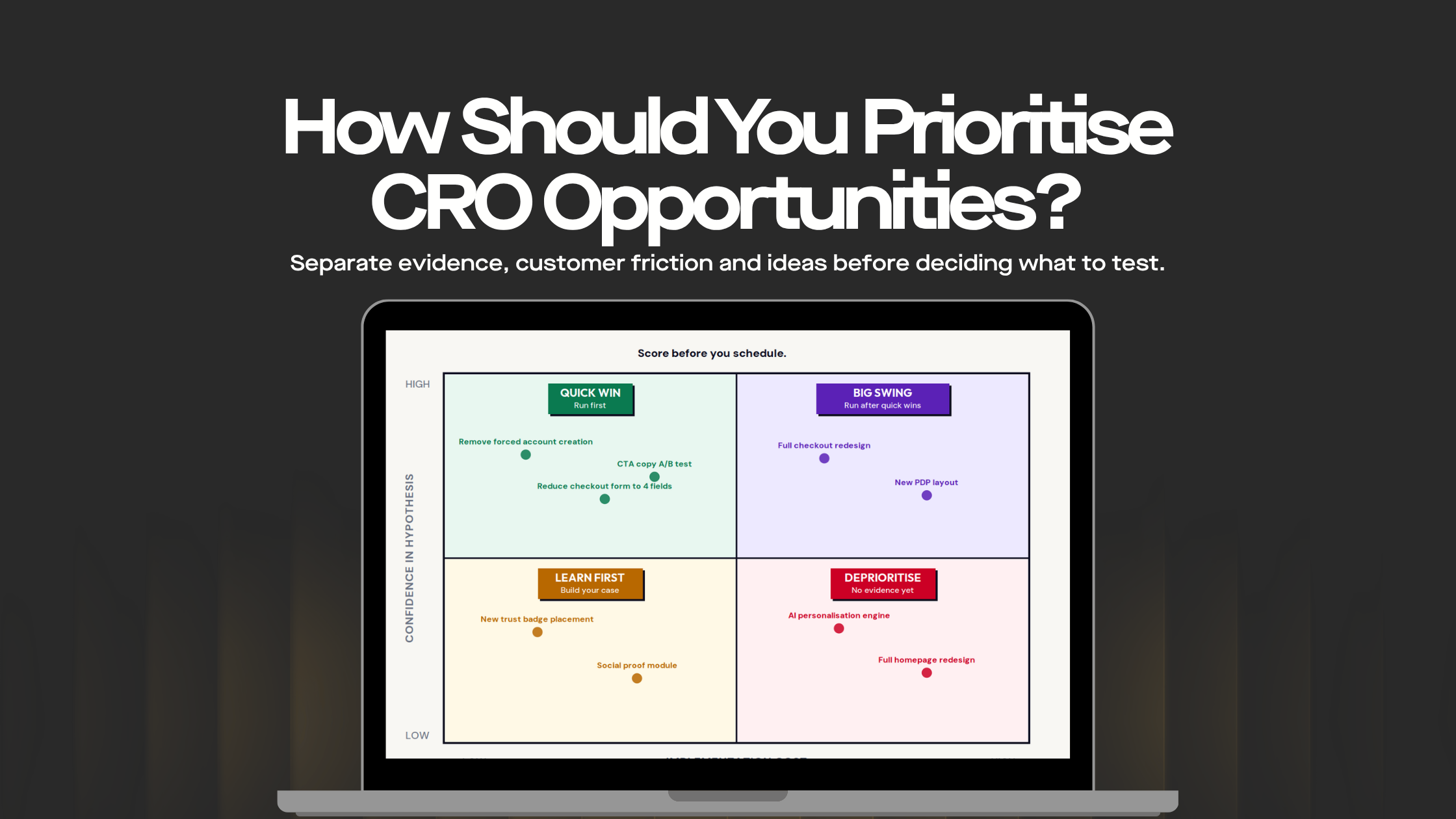
An effort-potential matrix can be useful here because it gives teams a simple way to compare opportunities that have different levels of expected value and implementation effort.
A major checkout redesign may appear attractive because of the number of customers passing through checkout, but it can also introduce significant technical and operational risk.
That trade-off becomes much more important as Black Friday approaches.
6. A Practical CRO Prioritisation Framework
Before applying a prioritization framework or scoring model, classify the opportunity according to the action it actually requires.
For DIGITXL, a practical way to think about the CRO backlog is to ask whether each opportunity should be fixed, researched, tested or deferred.
6.1 Fix problems that are already understood
Some problems do not need experimentation.
Broken payment functionality, incorrect pricing, missing tracking, broken links and obvious technical problems should generally be resolved rather than placed into an A/B test queue.
The same applies to serious usability problems where the appropriate correction is already clear.
If customers are unable to complete a checkout line because of a technical failure, there is little value in creating an experiment to determine whether the experience should work properly.
6.2 Research problems that are not understood
Research becomes more valuable when the team has evidence that something is wrong but cannot explain the reason.
For example, if onboarding drop-off is increasing but the available analytics cannot show why, additional research may reveal that customers are confused about a form, missing important information or encountering an unexpected requirement.
Likewise, usability testing may reveal that a sign-up process creates hesitation before customers reach an embedded form.
The research should answer a specific question rather than becoming an open-ended exercise.
6.3 Test credible hypotheses
An opportunity is ready for an A/B test when the team understands the problem, has a credible hypothesis and can realistically measure the outcome.
The experiment should have a defined primary metric and a clear reason for being run.
The result should provide useful evidence regardless of whether the variation wins, loses or produces an inconclusive result.
6.4 Defer ideas that do not justify the investment
Some opportunities are valid but simply not important enough to prioritise now.
They may have limited evidence, low traffic exposure, minimal commercial impact or a high implementation cost.
Keeping those ideas in the backlog allows the team to revisit them later without allowing them to consume resources that could be used on stronger opportunities.
7. What Ecommerce Teams Should Prioritise Before Black Friday
Black Friday changes the balance between experimentation and stability.
During normal trading, an ecommerce team may have more time to investigate unexpected results and make additional changes. As peak trading approaches, the focus should increasingly move towards resolving known issues, validating important customer journeys and avoiding unnecessary risk.
7.1 Check measurement before making CRO decisions
Review the events and transactions that matter to the business.
Make sure important conversion actions are being recorded correctly and investigate significant discrepancies between analytics and other business systems.
Supporting documents such as measurement plans, tracking specifications and previous implementation notes can also help the team understand whether a reported change reflects customer behaviour or a measurement issue.
7.2 Review high-value customer journeys
Focus on journeys that have meaningful traffic exposure and a clear connection with commercial outcomes.
For ecommerce, this may include category discovery, product pages, cart and checkout. For other businesses, it could involve lead forms, account creation or onboarding.
The point is not to review every page equally. The review should reflect where customers and commercial value are concentrated.
7.3 Review mobile behaviour
If mobile represents a substantial proportion of your traffic, examine the journeys that matter most on smaller screens.
Review navigation, content visibility, form interaction, product information and checkout behaviour. Heatmap data and scrolling behaviour can help identify areas that deserve closer investigation, while usability testing can provide context around why the behaviour is occurring.
7.4 Review promotional clarity
Black Friday customers are often comparing offers quickly.
Pricing, discount conditions, delivery information, eligibility requirements and exclusions should be clear enough for customers to make a decision without unnecessary searching.
The promotional experience also needs to remain consistent with the brand identity. A conversion improvement that creates confusion or damages trust may not be a worthwhile trade-off.
7.5 Decide what should be frozen
Not every change should be made before peak trading.
A major homepage redesign or checkout redesign may be appropriate at another point in the year, but introducing substantial changes shortly before Black Friday can create unnecessary risk if there is not enough time for development, testing and monitoring.
A prioritisation system should therefore include a decision about what not to change before peak.
8. Common CRO Prioritisation Mistakes
8.1 Choosing the highest-traffic page
Traffic is useful for understanding exposure, but it does not automatically determine priority.
A homepage may attract significantly more visitors than checkout, while a checkout problem may have a much more direct effect on completed purchases.
The commercial role of the journey needs to be considered alongside traffic data.
8.2 Treating a scoring model as a prediction
A scoring model helps structure decisions. It does not predict whether an experiment will produce a positive result.
The score should therefore be used to compare opportunities and make trade-offs visible rather than presented as an objective measure of expected uplift.
8.3 Copying competitors without understanding the customer
A competitor’s website can provide ideas, but it does not provide evidence that the same change will work for your customers.
Customer psychology, product category, pricing, brand identity and traffic sources can all influence how a particular experience performs.
Competitor research should therefore generate questions rather than determine the solution.
8.4 Treating every heatmap pattern as a problem
Heatmaps can show clicks, movement and interaction patterns, but they do not explain customer motivation on their own.
A section receiving little interaction may be irrelevant to most visitors, or it may contain information that customers cannot find.
Heatmap data becomes more useful when combined with other measurement techniques and qualitative evidence.
8.5 Testing without enough traffic
A test needs sufficient traffic and conversions to generate useful learning within a reasonable timeframe.
Running too many simultaneous experiments can spread traffic across multiple variations and make the results harder to interpret.
Testing capacity should therefore be considered when the roadmap is being created.
8.6 Making large changes too close to Black Friday
A significant website release requires time for development, QA, measurement validation and monitoring.
If there is not enough time to understand the impact of a change before peak trading, the safer decision may be to defer it until after Black Friday.
9. How DIGITXL Approaches CRO Prioritisation
At DIGITXL, CRO prioritisation starts with understanding the customer problem rather than assuming that every observation should become an experiment.
The approach combines digital analytics, behavioural analysis, UX research, funnel analysis, heatmaps, session recordings, hypothesis development, experiment prioritisation and impact measurement. This gives the team several ways to investigate a conversion opportunity before deciding what action is appropriate. NEW CRO Page Convo (1)
That distinction is important when a CRO Consultant is working with a large backlog. A technical problem may need to be fixed directly. A behaviour that is visible but poorly understood may require research. A well-defined problem with a credible hypothesis may be suitable for an A/B test, while a low-impact opportunity can remain in the backlog until it becomes more relevant.
DIGITXL’s CRO methodology also connects discovery and analysis with experimentation and impact measurement. The process begins with understanding the business, customers, funnel structure and conversion objectives before moving into behavioural analysis, hypothesis development and testing. NEW CRO Page Convo (1)
For an ecommerce team preparing for Black Friday, that creates a more useful operating model than simply trying to increase the number of tests completed.
The team can enter peak trading with greater clarity about which problems have been resolved, which opportunities have enough evidence to test and which changes should wait until there is more time to validate them properly.
DIGITXL can review your analytics, customer behaviour and key conversion journeys, then turn those findings into a prioritised CRO roadmap that your team can act on before Black Friday.
Talk to DIGITXL about your CRO priorities →
10. Conclusion
CRO prioritisation is ultimately about deciding where the team should spend its limited time, traffic and development capacity.
A good prioritization framework does not begin by asking which test idea has the highest score. It begins by asking whether there is enough evidence that a meaningful customer problem exists.
From there, the team can investigate the friction behind the behaviour, develop a clear hypothesis and decide whether the appropriate response is to fix the issue, conduct further research, run an A/B test or defer the opportunity.
That process is particularly valuable before Black Friday because peak trading increases both the commercial impact of customer journey problems and the risk associated with last-minute changes.
By the end of October, an ecommerce team should have a clearer understanding of its measurement, its highest-value customer journeys and the CRO opportunities that can realistically be addressed before peak trading.
The result should not be a longer testing backlog. It should be a more defensible roadmap in which each priority has a clear reason for being there.
That is what effective CRO prioritisation should achieve: better use of testing capacity, fewer assumptions and a clearer connection between customer experience and commercial performance.