- Google Analytics
Server-Side Tracking in 2026: What Marketing Teams Should Fix First
03 Aug 2026
Server-side tracking has moved from a technical upgrade to a marketing measurement priority.
Marketing teams are dealing with weaker browser-based tracking, consent requirements, ad platform data gaps and pressure to prove campaign performance. At the same time, paid media, SEO, CRO and analytics teams all need cleaner data to make better decisions.
This is why Server-Side Tracking in 2026 should not be treated as a “nice to have”. It should be part of the core measurement setup.
But many teams make the mistake of trying to fix everything at once. They move tags to the server, add platform APIs, change consent settings and rebuild reporting before checking whether the basics are working.
The better approach is to fix the data foundation first, then improve platform integrations, privacy controls and reporting.
1. What Should Marketing Teams Fix First?
Marketing teams should fix consent, GA4 event quality, conversion tracking, deduplication and platform API routing before expanding server-side tracking.
If these foundations are weak, server-side tracking can simply send poor-quality data through a more complex system.
The first priorities should be:
- Consent setup
- GA4 event quality
- Ecommerce and lead conversion tracking
- Event deduplication
- Meta Conversions API and Google Ads conversion routing
- Data governance
- Reporting validation
- Ongoing monitoring
This keeps server-side tracking focused on business outcomes, not just technical implementation.
2. What Is Server-Side Tracking?
Server-side tracking means website events are sent to a server endpoint before being passed to analytics and advertising platforms.
In a normal browser-based setup, tags fire directly from the user’s browser to platforms such as GA4, Google Ads or Meta. In a server-side setup, the website sends data to a controlled server environment first. From there, the business can decide what data is shared, where it goes and how it is cleaned.
This can help improve control, performance and data quality. However, server-side tracking does not automatically fix poor tracking.
It only works well when consent, event names, parameters, deduplication, platform APIs and reporting are configured properly.
3. What Does Server-Side Tracking Fixing Mean?
Server-side tracking fixing means auditing and repairing the consent, event, conversion, deduplication and platform routing issues that stop server-side tracking from producing reliable marketing data.
It is not just about moving tags into a server container.
It is about making sure the right events fire, the right data is passed, users’ consent choices are respected, and reports can be trusted by marketing teams.
4. Fix-First Audit Checklist
Before building or expanding a server-side setup, marketing teams should use a simple audit checklist.
| Area | First Fix | Why It Matters |
| Consent | Confirm consent fires before tags | Prevents incorrect data collection and sharing |
| GA4 events | Validate key events and parameters | Improves reporting quality |
| Ecommerce | Check transaction ID, value and currency | Prevents revenue gaps |
| Lead tracking | Confirm form and booking events | Improves lead reporting |
| Deduplication | Pass a consistent event ID | Avoids double-counting |
| Platform APIs | Validate Meta and Google Ads events | Improves ad platform signals |
| Reporting | Compare analytics data with backend data | Confirms whether numbers are reliable |
| Monitoring | Build a dashboard for errors and gaps | Prevents silent tracking failures |
This gives teams a clear order of work instead of treating server-side tracking as one large technical project.
4.1 Fix Consent Before Anything Else
Consent should be the first priority.
If consent is not configured correctly, your server-side setup may send the wrong data, block useful data or create compliance issues.
Marketing teams should check:
- Is the consent banner firing before tags?
- Are consent choices being passed correctly?
- Are analytics and advertising consent handled separately?
- Are denied users treated properly?
- Is Consent Mode configured across GA4, Google Ads and GTM?
- Are consent states visible during testing?
This is not only a compliance task. It directly affects reporting, remarketing, enhanced conversions and campaign optimisation.
A poor consent setup can make server-side tracking look broken even when the server container itself is working.
4.2 Audit GA4 Events Before Moving Them Server-Side
Do not move messy events into a server-side container.
Before changing the tracking architecture, check whether GA4 events are already clean.
Start with the highest-value events first:
- purchase
- generate_lead
- form_submit
- booking_confirmed
- add_to_cart
- begin_checkout
- sign_up
Then review:
- Event names
- Parameters
- Conversion events
- Ecommerce events
- Form submissions
- Thank-you page tracking
- User ID, where appropriate
- Cross-domain tracking
- Duplicate events
- Missing events
The question is not only whether the event fires. The question is whether the event includes the right value, product details, transaction ID, lead type and user journey context.
For a business investing in SEO services, CRO or paid media, poor GA4 events can make every channel report harder to trust.
4.3 Fix Ecommerce and Lead Conversion Tracking
Server-side tracking is often introduced because marketing teams want better conversion data.
But before adding more tools, check the actual conversion points.
For ecommerce, review:
- Product IDs
- Product names
- Categories
- Prices
- Discounts
- Tax and shipping
- Transaction IDs
- Purchase value
- Currency
- Refund tracking
For lead generation, review:
- Form submissions
- Phone clicks
- Booking confirmations
- Quote requests
- Newsletter sign-ups
- CRM lead IDs
- Lead quality fields
A purchase event without transaction ID is a problem. A form submission without lead type is limited. A conversion with no value is difficult to optimise.
Server-side tracking should improve conversion quality, not hide weak event design.
4.4 Fix Deduplication Across Browser and Server Events
Many businesses run browser-side and server-side events at the same time. That is normal, but it creates a risk: duplicate conversions.
Deduplication helps platforms understand that two signals relate to the same real-world event.
For example, a purchase may be sent from the browser and from the server. Without proper deduplication, the platform may count it twice or process it incorrectly.
Marketing teams should check:
- Is there a unique event ID?
- Is the same event ID passed from browser and server?
- Are transaction IDs consistent?
- Are event timestamps logical?
- Are test events showing duplicates?
- Are platforms reporting unexpected conversion spikes?
Server-side tracking should make measurement cleaner. If deduplication is wrong, it can make reporting worse.
4.5 Set Up Platform APIs Properly
Server-side tracking often includes sending data to advertising platforms through APIs.
For Meta, this usually means the Conversions API. For Google, teams may use server-side Google Tag Manager, enhanced conversions, Google Ads conversion tracking or Google tag gateway.
Each platform needs clean, consent-aware and correctly formatted data.
Check:
- Are required fields included?
- Are user identifiers handled with consent?
- Are event names mapped correctly?
- Is purchase value passed accurately?
- Are test tools showing successful receipt?
- Are match quality indicators improving?
- Are failed requests monitored?
This is where technical and marketing teams need to work together. Platform APIs are not just developer tasks. They affect ad learning, campaign reporting and optimisation.
4.6 Control What Data Leaves the Server
One of the main benefits of server-side tracking is control.
Instead of every browser tag sending data directly to third parties, the business can decide what is shared from the server environment.
Marketing teams should define:
- Which platforms receive which events
- Which parameters are removed or transformed
- Which user identifiers are allowed
- Which events require consent
- Which tags fire by country or region
- Which data is stored, forwarded or blocked
Server-side tracking should not be used to bypass user choice. It should be used to improve control, accuracy and accountability.
4.7 Validate Reporting Before and After Launch
A common mistake is launching server-side tracking and assuming the data is better.
Marketing teams should compare data before and after implementation.
Review:
- GA4 sessions
- GA4 conversions
- Google Ads conversions
- Meta conversions
- Ecommerce revenue
- Form submissions
- CRM leads
- Add-to-cart events
- Checkout events
- Purchase events
Look for sharp changes that do not make business sense.
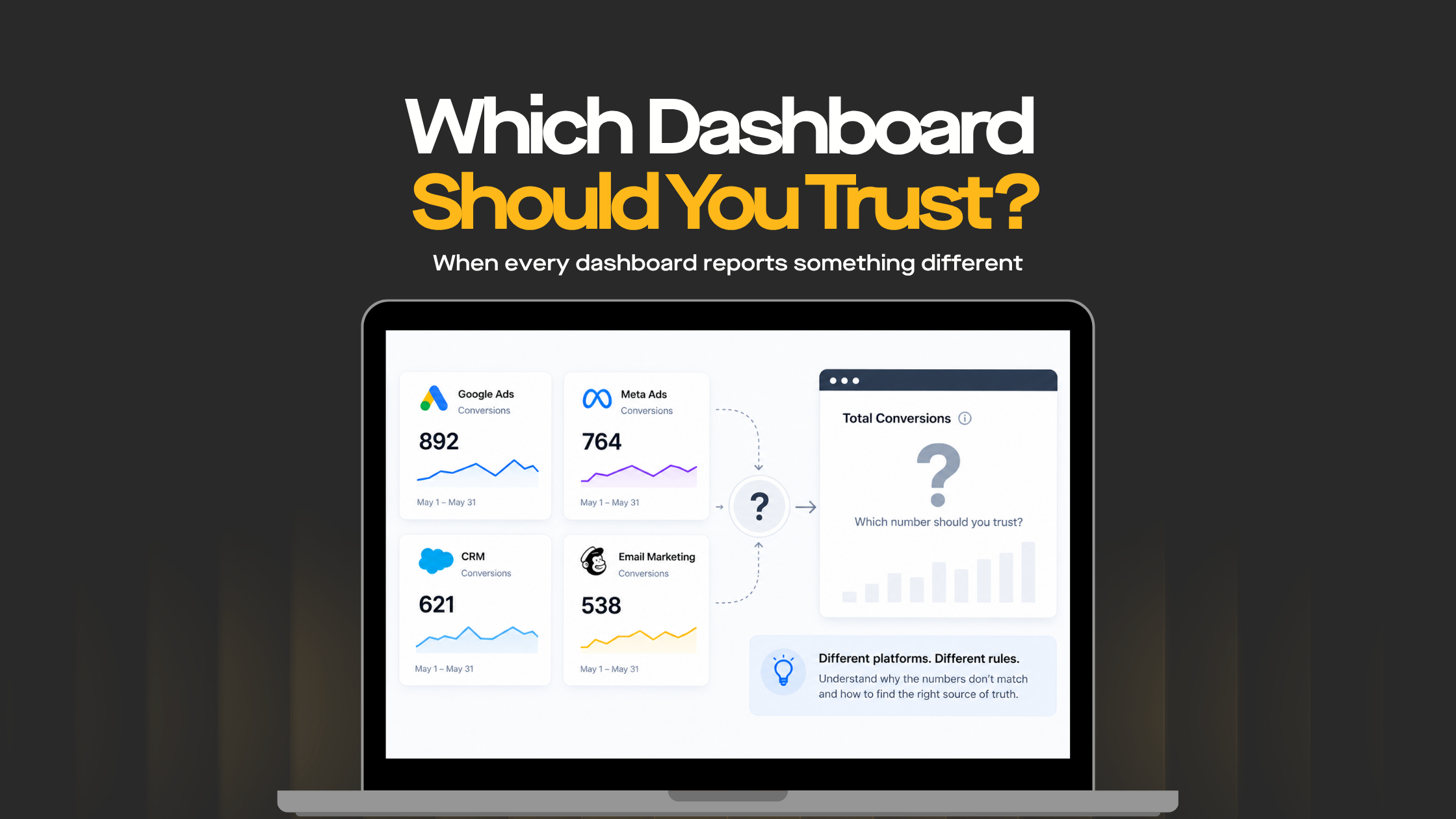
For example, before fixing tracking, Meta may report 180 purchases, GA4 may report 120, and Shopify may show 140 orders. These numbers will not always match perfectly, but the gaps should be explainable and stable.
After server-side tracking fixing, the goal is not identical reporting across every platform. The goal is cleaner data, fewer unexplained gaps and more confidence in the numbers.
4.8 Build a Monitoring Dashboard
Server-side tracking should not be set and forgotten.
Marketing teams need a dashboard that shows whether the setup is still working.
A practical dashboard can include:
| Area | What to Monitor |
| GA4 events | Event volume, conversions, revenue and parameters |
| Server events | Requests, errors and failed tags |
| Consent | Granted and denied consent rates |
| Ecommerce | Purchases, revenue, transaction IDs and refunds |
| Paid media | Google Ads and Meta conversion trends |
| CRM | Leads, lead quality and closed revenue |
| Data gaps | Missing IDs, missing values and duplicate events |
This is where an analytics-led optimisation agency can provide real value. The work does not end when server-side tracking goes live. It needs monitoring, validation and improvement.
4.9 Align Server-Side Tracking With SEO and CRO
Server-side tracking is often discussed by paid media teams, but it also affects SEO and CRO reporting.
For SEO, better conversion tracking can show which landing pages and organic journeys generate leads or sales. For CRO, cleaner event data helps identify where users drop off and which experiments affect conversion behaviour.
For a business working with a seo agency Brisbane team, server-side tracking can help show whether organic landing pages are generating real enquiries, bookings or sales — not just traffic.
This matters because SEO services are often judged on rankings, traffic and conversions. If conversion tracking is unreliable, SEO performance may be underreported or misunderstood.
5. Common Mistakes to Avoid
Do not start with server infrastructure before auditing current events.
Do not send every possible parameter to every platform.
Do not ignore consent.
Do not assume server-side tracking will fix a poor GA4 setup.
Do not skip deduplication.
Do not validate only in preview mode.
Do not forget to compare against backend sales or CRM leads.
Do not launch without a monitoring dashboard.
These mistakes are common because teams often treat server-side tracking as a technical implementation rather than a measurement strategy.
6. How an Agency Can Help
Server-side tracking sits across analytics, paid media, SEO, consent, development and reporting.
An optimisation agency can help define what needs to be fixed first, instead of simply moving tags into a server container. A seo agency can help connect improved tracking with organic landing page performance, SEO services reporting and conversion insights.
The right partner should be able to review:
- Consent setup
- GA4 event quality
- Ecommerce tracking
- Lead tracking
- Server-side GTM
- Meta Conversions API
- Google Ads conversion tracking
- Looker Studio dashboards
- CRM validation
- Data governance
Server-side tracking is not about collecting more data. It is about collecting better data and using it responsibly.
7. Final Thoughts
Server-side tracking in 2026 is not only a technical upgrade. It is a measurement improvement project.
The teams that get the most value will not be the ones that move the most tags server-side. They will be the ones that fix the foundations first.
Start with consent. Then fix GA4 events, ecommerce or lead conversions, deduplication, platform APIs, data governance and reporting validation.
For marketing teams, server-side tracking should answer one simple question:
Can we trust the data we are using to make marketing decisions?
If the answer is no, that is where the work should begin.
8. FAQs
Q. What is server-side tracking?
A. Server-side tracking sends website event data to a server endpoint before passing it to analytics and advertising platforms. This gives businesses more control over what data is shared and how it is processed.
Q. Why does server-side tracking matter in 2026?
A. It matters because browser-based tracking, consent settings and platform restrictions can create data gaps. Server-side tracking can help improve data quality when it is implemented correctly.
Q. What should marketing teams fix first?
A. Marketing teams should first fix consent setup, GA4 event quality, ecommerce or lead conversion tracking, deduplication, platform API routing and reporting validation.
Q. Does server-side tracking replace GA4?
A. No. Server-side tracking does not replace GA4. It changes how data is collected and routed before being sent to GA4 and other platforms.
Q. Can server-side tracking improve paid media performance?
A. It can improve paid media measurement and signal quality when clean, consent-aware conversion data is sent to platforms such as Google Ads and Meta.
Q. How can a seo agency use server-side tracking?
A. A seo agency can use cleaner conversion data to understand which organic landing pages, content journeys and SEO services are contributing to leads, sales and revenue.

Recent Posts


Case Studies
Business News Australia
On Track Meals
Suncorp