1. Why Does Marketing Performance Drop After Consent Mode Is Implemented?
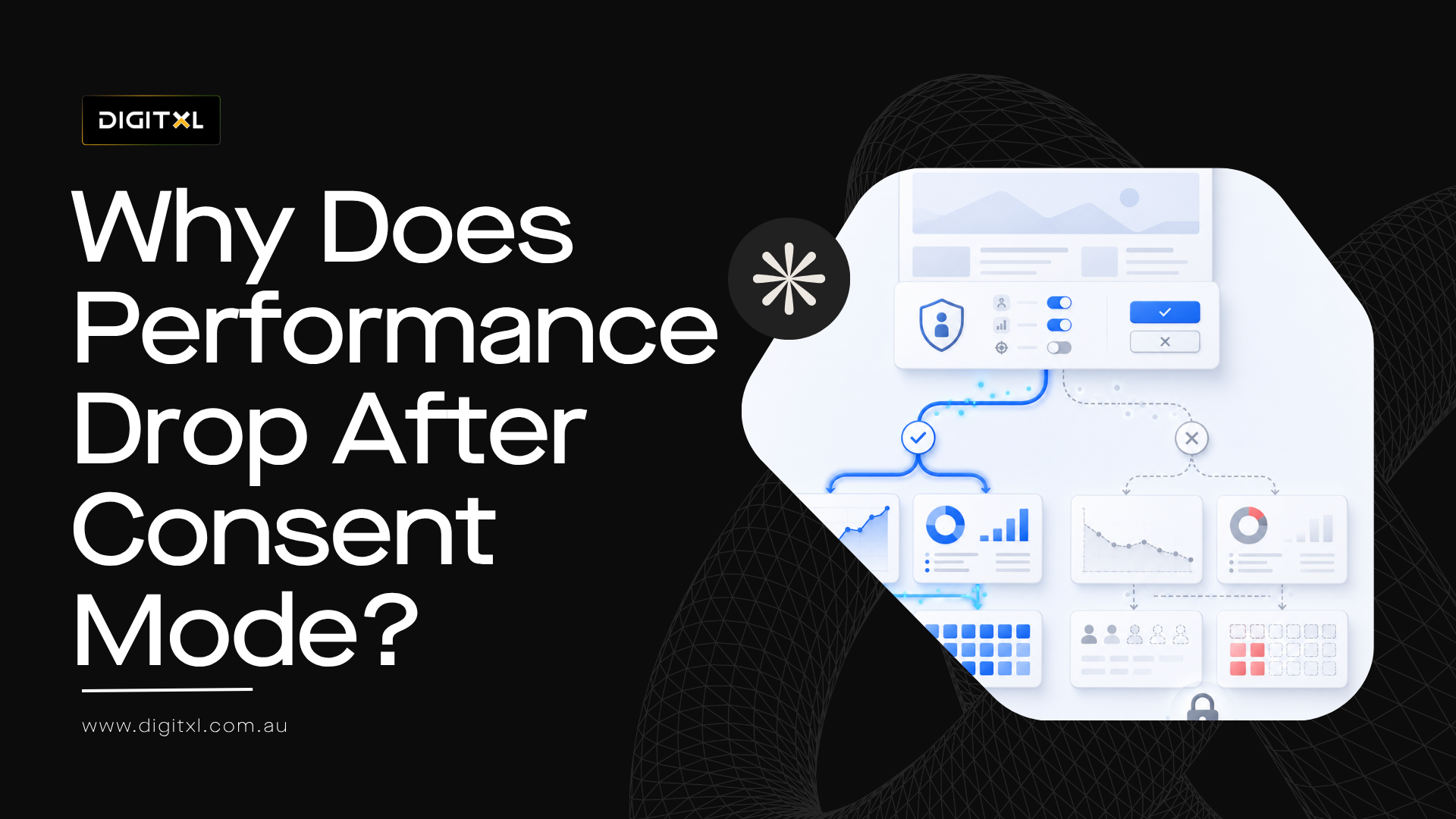
Marketing performance can appear to decline after Consent Mode is implemented because the measurement environment changes when users grant or deny consent.
Depending on the setup, Google Analytics and Google Ads may have access to less directly observable data, remarketing audiences may become smaller and some conversions may rely more heavily on modelling. In an advanced Consent Mode implementation, Google tags can send cookieless pings when consent is denied, allowing Google to use privacy-aware signals to help model gaps in measurement.
That can make platform reporting look weaker even when underlying leads, sales or revenue have not fallen by the same amount.
A genuine implementation issue can create similar symptoms. Consent states may not update correctly, tags may be blocked unnecessarily, conversion events may fail or the Consent Management Platform may not communicate properly with Google Tag Manager.
When marketing performance drops after implementing Consent, the most useful approach is to separate three things before reacting:
Commercial performance → Measurement visibility → Implementation quality
If customer outcomes are stable but platform reporting has fallen, the issue may be measurement. If both are falling, there may be a genuine marketing problem. If the change is sudden and unusually large, the implementation should be checked first.
2. Did Marketing Performance Actually Drop, or Did Measurement Change?
This is the first question teams should answer.
Imagine a B2B organisation generated 500 enquiries before Consent Mode was implemented and continues to receive roughly the same number afterwards. Google Ads, however, previously reported 460 conversions and now reports 360.
If the business looks only at Google Ads, performance appears to have dropped significantly. If CRM lead volume and opportunity creation remain stable, the commercial picture looks very different.
The same issue can occur in ecommerce. Google Analytics may report fewer users or attributed purchases while the ecommerce platform continues to record similar order and revenue levels.
That does not mean platform data should be ignored. It means teams need to recognise that Google Analytics, Google Ads and the business system are answering different questions.
A useful starting point is to compare the change across several layers.
| What changed? | What it may indicate |
| Google Ads conversions fell, but CRM leads remained stable | Attribution or directly observable conversion data may have changed |
| Google Analytics traffic fell, but ecommerce revenue remained similar | Measurement visibility may have reduced rather than demand |
| Google Ads, CRM leads and revenue all declined | There may be a genuine performance problem |
| Remarketing audiences became smaller | Fewer users may now be eligible for personalised advertising |
| Conversions fell sharply on the implementation date | Consent or tracking configuration should be reviewed |
| Performance weakened gradually over several weeks | Campaign, market or seasonal factors may also be involved |
This comparison helps prevent a common mistake: reacting to a change in data collection as though it were automatically a marketing failure.
3. What Changed With Google Consent Mode V2?
Google Consent Mode V2 introduced a more granular way for businesses to communicate user consent choices to Google. In addition to analytics_storage and ad_storage, the updated framework includes ad_user_data and ad_personalization. These signals help determine whether user data can be sent to Google for advertising measurement and whether it can be used for personalised advertising.
This became particularly important for businesses receiving traffic from the European Economic Area, where Google requires relevant consent signals for certain measurement, remarketing and ad personalisation use cases.
For marketing teams, Consent Mode v2 should not be treated as a simple “tracking on” or “tracking off” setting. Different forms of user consent can affect analytics storage, advertising storage, measurement and personalisation in different ways.
This means the effect on Google Analytics, Google Ads and remarketing depends on how the consent architecture has been designed, how the Consent Management Platform communicates with Google and whether the implementation reflects the organisation’s privacy regulations and internal governance requirements.
4. Basic and Advanced Consent Mode Can Create Different Reporting Outcomes
Not every Consent Mode implementation behaves in the same way.
With basic Consent Mode, Google tags can be blocked until the visitor grants the required consent. If consent is denied, no data is sent to Google through those blocked tags.
With advanced Consent Mode, Google tags can load with denied defaults and adjust their behaviour based on the user’s choice. When consent is denied, cookieless pings can still be sent to Google without reading or writing the relevant analytics or advertising cookies. These signals can then contribute to conversion and behavioural modelling.
From a marketing perspective, this means two businesses can both say they have implemented Consent Mode v2 while seeing very different effects on reporting.
The important point is not simply whether Consent Mode exists. Teams need to understand how it has been configured, which user consent signals are being passed and how those choices affect data collection across Google Analytics and Google Ads.
5. Why Can Google Ads Conversions Fall?
Google Ads relies on conversion signals to understand which campaigns, clicks and users are contributing to valuable outcomes.
Once Consent Mode is introduced, some of those signals may become less directly observable when users decline the relevant advertising consent. That can affect reported conversions, attribution, audience eligibility and the amount of information available to automated bidding.
The size of the impact will depend on factors such as consent rate, implementation type, conversion volume, campaign structure and whether modelling is available.
The Conversion Linker is also relevant to this measurement chain because it helps Google Ads store ad-click information used for conversion measurement. Under Consent Mode, its behaviour is influenced by the relevant consent settings, so teams should confirm that the Conversion Linker and Google Ads conversion tags are behaving as intended rather than being blocked more aggressively than required. Google lists Conversion Linker among the tags that support consent-aware behaviour.
A 20% decline in reported Google Ads conversions does not necessarily mean that campaign-generated sales or enquiries have fallen by 20%. Before reducing budgets, the business should compare platform reporting with actual leads, purchases and revenue.
If CRM lead volume, ecommerce orders or backend revenue remain relatively stable, the first question should be whether measurement changed rather than whether the campaign suddenly became less effective.
6. How Machine Learning Supports Consent-Aware Measurement
Consent Mode does not simply remove unavailable data and leave a permanent blank in every report.
Where the implementation and account are eligible, Google can use machine learning to estimate some conversion or behavioural activity that cannot be directly observed.
The modelling works from available consented signals and, in advanced implementations, cookieless pings. Google states that cookieless pings can be used to improve advertiser-specific conversion modelling and behavioural modelling while not being used to identify individual users for remarketing or profile building.
This is where machine learning can help reduce some of the measurement gaps introduced by stronger privacy controls.
However, modelling should not be treated as a perfect replacement for directly observed user data.
The quality and availability of modelling depend on implementation, traffic and conversion volume, and whether the account meets Google’s eligibility requirements.
A large ecommerce website with substantial daily activity may provide enough signals for modelling to become useful. A smaller B2B website generating relatively few enquiries each month may have less data available.
A more practical way to assess the situation is to understand how much of the customer journey can still be observed directly, what can be modelled and what needs to be reconciled against first-party business data.
7. Consent Mode Can Reveal Tracking Problems That Were Already There
Sometimes Consent Mode does not create the measurement problem. It exposes weaknesses that were already present.
A business may discover that Google Ads has been counting a conversion when somebody clicks the submit button rather than when the form is successfully received. An ecommerce team may find that purchase events do not reconcile with completed orders. A marketing team may realise that the same conversion is being counted differently across Google Ads, Google Analytics and the CRM.
Before Consent Mode, these inconsistencies may have been less noticeable because a larger volume of directly observable user data created the appearance of a healthy measurement setup.
Once user consent becomes another part of the tracking logic, those inconsistencies become harder to ignore.
That is why a Consent Mode v2 project should include a review of the underlying conversion measurement rather than simply adding consent signals to an existing implementation.
For lead-generation websites, confirm that a conversion represents a successful enquiry rather than a button click. For ecommerce, reconcile transaction IDs, revenue and purchase events against the commerce platform. For paid media, confirm that the conversion actions used for bidding still represent meaningful business outcomes.
8. Is User Consent Being Passed Correctly Across the Setup?
A consent banner alone does not create a reliable Google Consent Mode V2 implementation.
The user’s choice needs to be captured by the Consent Management Platform and then communicated correctly to the tags and systems that depend on it.
This creates several points where things can go wrong.
Consent may default incorrectly when the page first loads. The consent state may not update after a user makes a choice. One part of the website may use the correct settings while another does not. Google Tag Manager may contain additional blocking rules that prevent tags from behaving as intended, or a single-page application may fail to carry the consent state consistently between page changes.
The user experience of the consent banner also matters. A confusing consent interface can reduce trust, lower consent rates or make visitors unsure about what they are agreeing to. Privacy compliance and user experience therefore need to be considered together rather than treating the banner as a purely technical layer.
Businesses should also understand which privacy regulations and internal policies apply to their audience and geography. Consent Mode helps Google tags respond to user consent choices, but it does not determine whether a business’s banner, legal basis or wider data collection approach is compliant.
These problems can produce sharp reporting changes that look like a normal privacy-related reduction even though the implementation itself is responsible.
9. What Should You Check After Consent Mode Is Implemented?
A structured review can help distinguish expected measurement changes from genuine implementation problems.
| Check | What you are validating | Why it matters |
| Consent defaults | The correct consent state is applied before tags behave | Incorrect defaults can send or block user data unexpectedly |
| Consent updates | User consent choices are reflected correctly | Tags need to respond to the actual decision |
| Page coverage | Consent logic behaves consistently across the website | Partial implementation can distort Google Analytics reporting |
| GA4 events | Important events still fire when they should | Missing events can look like lost conversions |
| Google Ads conversions | Successful conversions still reach Ads correctly | Campaign optimisation depends on reliable signals |
| Conversion Linker | Ad-click measurement is not being blocked incorrectly | Supports reliable Google Ads conversion tracking |
| GTM and CMP interaction | Additional rules are not blocking tags unnecessarily | Double blocking can create avoidable data loss |
| CRM or backend reconciliation | Platform reporting still reflects commercial outcomes | Helps separate measurement change from real performance |
| Audience behaviour | Remarketing audiences change in line with consent | Identifies unexpected audience loss |
The purpose of this review is not to force data collection back to its pre-consent state. It is to make sure any decline is explainable and that the implementation is respecting user consent while still collecting the data that is legitimately available.
10. Why Can Remarketing Audiences Become Smaller?
A smaller remarketing audience after Consent Mode is introduced is not automatically a problem.
If fewer users have provided the consent required for personalised advertising, fewer users may be eligible to enter those audiences.
That is an expected consequence of respecting user consent and privacy regulations.
The useful question is whether the size of the reduction makes sense compared with the consent rate and audience logic.
If 30% of relevant users decline advertising consent and the remarketing audience declines by a similar amount, the behaviour may be understandable. If the audience falls by 80%, there may be something else happening in the implementation or audience setup.
This is why Consent Mode reporting should be interpreted alongside user consent behaviour rather than in isolation.
11. Automated Bidding May Need Time to Adjust
Automated bidding relies on conversion signals to understand which auctions are more likely to generate valuable outcomes.
When the volume or composition of those signals changes, bidding systems may need time to adapt.
This is another area where Google’s machine learning systems depend heavily on measurement quality. If consent settings, conversion events or user data inputs change significantly, automated systems may be working with a different signal mix than before.
The impact becomes harder to interpret when several changes are introduced at once. A business may launch a new CMP, redefine conversions, change bidding targets and adjust campaign budgets during the same week. If performance then changes, isolating the cause becomes almost impossible.
Consent Mode should therefore be treated as a meaningful measurement change rather than a simple technical release.
12. First-Party Commercial Data Should Become the Reference Point
As privacy regulations and user consent controls reduce the amount of directly observable marketing data, first-party business systems become even more important.
Google Analytics and Google Ads remain valuable, but they should not be expected to act as the final source of truth for every commercial decision.
For a B2B organisation, the measurement chain may look like:
Google Ads conversion → Google Analytics key event → CRM lead → qualified opportunity → closed revenue
For ecommerce, it may look more like:
Google Ads purchase → Google Analytics purchase → ecommerce order → payment or ERP revenue
Comparing these layers gives the business a better view of what has actually changed.
| Measurement layer | What it helps explain |
| Google Ads | Advertising-attributed and modelled outcomes |
| Google Analytics | Website and app behaviour under the configured consent setup |
| CRM | Lead quality, opportunity progression and sales outcomes |
| Ecommerce platform | Orders, revenue, refunds and product performance |
| Finance or ERP | Final recognised commercial outcomes |
The numbers will not always match exactly, and they are not supposed to answer the same question. What matters is understanding the relationship between them well enough to explain any significant change.
13. How to Fix Performance Drop After Enabling Consent Mode
When marketing performance drops after implementing Consent, the response should not begin with cutting budgets or weakening privacy controls. It should begin with diagnosis.
13.1 Check the Commercial Outcome
Start with what actually happened to the business.
Did leads, orders, qualified opportunities or revenue decline? If the commercial outcome remains relatively stable while Google Analytics or Google Ads reports a significant drop, investigate measurement before assuming marketing performance has deteriorated.
13.2 Check Measurement Visibility
Compare Google Analytics, Google Ads and other marketing platforms before and after implementation. Look at changes in conversion attribution, directly observable events, traffic, audience size and the volume of user data available under the new consent framework.
13.3 Validate Consent Mode V2
Confirm that analytics_storage, ad_storage, ad_user_data and ad_personalization are being set and updated correctly where relevant. This is particularly important for organisations receiving traffic from the European Economic Area and other regions where user consent requirements affect measurement and personalisation.
13.4 Check Cookieless Pings and Tag Behaviour
For advanced Consent Mode, confirm that cookieless pings are behaving as expected when consent is denied and that tags such as Google Analytics, Google Ads and Conversion Linker are not being blocked unnecessarily.
13.5 Reconcile Platform Reporting With First-Party Data
Compare Google Ads and Google Analytics with CRM leads, ecommerce transactions, backend revenue or other first-party commercial systems.
13.6 Review the User Experience
Check whether the consent banner is clear, usable and aligned with privacy requirements. A poor user experience can affect both consent behaviour and trust.
13.7 Respond to Campaign Performance
Only once the previous layers are understood should teams make significant decisions around bidding, budgets, targeting or campaign strategy.
This provides a much stronger answer to how to fix performance drop after enabling Consent Mode because it identifies the cause before changing the marketing activity.
14. Common Mistakes After Consent Mode Is Implemented
14.1 Treating Consent Mode V2 as Only a Technical Requirement
Consent Mode v2 affects user consent, data collection, measurement, remarketing and advertising personalisation. It should be reviewed by marketing, analytics, privacy and technical teams rather than treated as a GTM-only project.
14.2 Assuming Every Reporting Decline Is a Marketing Decline
A drop inside Google Ads or Google Analytics does not automatically mean fewer customers converted. Compare the change with CRM, ecommerce and revenue data first.
14.3 Blocking Tags Unnecessarily
Consent Mode can be implemented alongside additional blocking rules in Google Tag Manager or the CMP. If those controls overlap incorrectly, Google Analytics, Google Ads or the Conversion Linker may be prevented from behaving as intended.
14.4 Ignoring Cookieless Pings
In advanced Consent Mode, cookieless pings can support privacy-aware modelling when consent is denied. Blocking them unnecessarily may reduce the quality of advertiser-specific modelling.
14.5 Expecting Historical Reports to Remain Directly Comparable
The data collection environment has changed. Comparing pre-consent and post-consent performance without acknowledging that change can produce misleading conclusions
14.6 Ignoring Privacy Regulations
Consent Mode helps Google tags respect user consent signals, but it does not replace the organisation’s responsibilities under applicable privacy regulations.
14.7 Expecting Machine Learning to Recover Every Gap
Machine learning can improve modelling, but its effectiveness depends on implementation, traffic, conversion volume and available signals. It should complement first-party measurement rather than replace it.
15. How Should Marketing Teams Measure Performance After Consent Mode?
Once Consent Mode is live, marketing teams should establish a new measurement baseline rather than judging performance only against the old data collection environment.
Before and after implementation, review metrics such as:
| Metric | What to look for |
| User consent rate | How much of the audience grants relevant consent |
| Google Analytics users and sessions | Whether directly observable activity has changed |
| Google Analytics key events | Whether important customer actions remain measurable |
| Google Ads conversions | How advertising attribution has changed |
| Cookieless ping behaviour | Whether advanced Consent Mode is providing expected privacy-aware signals |
| Remarketing audience size | Whether eligibility has reduced as expected |
| CRM leads | Whether actual lead generation has changed |
| Qualified opportunities | Whether commercial lead quality is stable |
| Ecommerce orders | Whether transaction volume has changed |
| Revenue | Whether the business outcome matches the reporting trend |
The relationship between these numbers is often more useful than any one metric by itself.
If Google Ads conversions fall by 18% while CRM leads fall by only 2%, that deserves a very different response from a situation where Google Ads conversions, CRM leads and revenue all decline by roughly the same amount.
16. DIGITXL Point of View
When marketing performance drops after implementing Consent Mode, Consent Mode itself should not automatically be blamed until the business has separated real customer behaviour, measurement visibility and implementation quality.
Those three issues can look almost identical in a marketing dashboard.
A decline in Google Ads conversions could mean campaigns are genuinely producing fewer outcomes. It could also mean that less user data is directly observable under the new consent setup, or that the implementation is blocking signals that should still be available.
Our recommended approach is:
Commercial outcome → User consent and data collection → Measurement change → Implementation validation → Campaign response
At DIGITXL, we would first check whether leads, orders or revenue actually changed. We would then review Google Analytics, Google Ads, Consent Mode v2, cookieless pings, Conversion Linker behaviour and the wider CMP/GTM setup to understand how measurement visibility shifted.
Only once those layers are understood should the marketing team respond through bidding, budget or campaign changes.
The purpose of Google Consent Mode V2 is not to preserve every historical marketing metric exactly as it was. The goal is to build a measurement setup that respects user consent and privacy regulations while still giving the business the most reliable view of performance available.
17. Final Thoughts
So, why does marketing performance drop after Consent Mode is implemented?
There is rarely one answer.
The business may genuinely be generating fewer conversions, but it may also be seeing less directly observable user data, changes in attribution, smaller eligible audiences or an implementation problem that needs to be corrected.
Consent Mode v2 also changes the way teams need to think about data collection. User consent, Google Analytics, Google Ads, machine learning, cookieless pings and first-party commercial data now need to be assessed as parts of the same measurement system rather than isolated tools.
The practical response is to start with commercial outcomes, understand how measurement changed, validate the Consent Mode implementation and then decide whether marketing activity actually needs to be adjusted.
For teams looking at how to fix performance drop after enabling Consent Mode, this diagnostic approach is much safer than reacting immediately to a lower number inside Google Ads or Google Analytics.
If your reporting changed significantly after Consent Mode was introduced, DIGITXL can help review the complete measurement setup across your Consent Management Platform, Google Tag Manager, Google Analytics, Google Ads, Conversion Linker and first-party business systems.
Our focus is on identifying whether the change comes from genuine campaign performance, expected consent-related measurement differences or an implementation issue that needs to be fixed.
Talk to DIGITXL about validating your Google Consent Mode V2 implementation and rebuilding confidence in your marketing measurement.

 Previous