- Ecommerce
How to Improve Marketing Attribution for Ecommerce in 2026?
16 Jun 2026
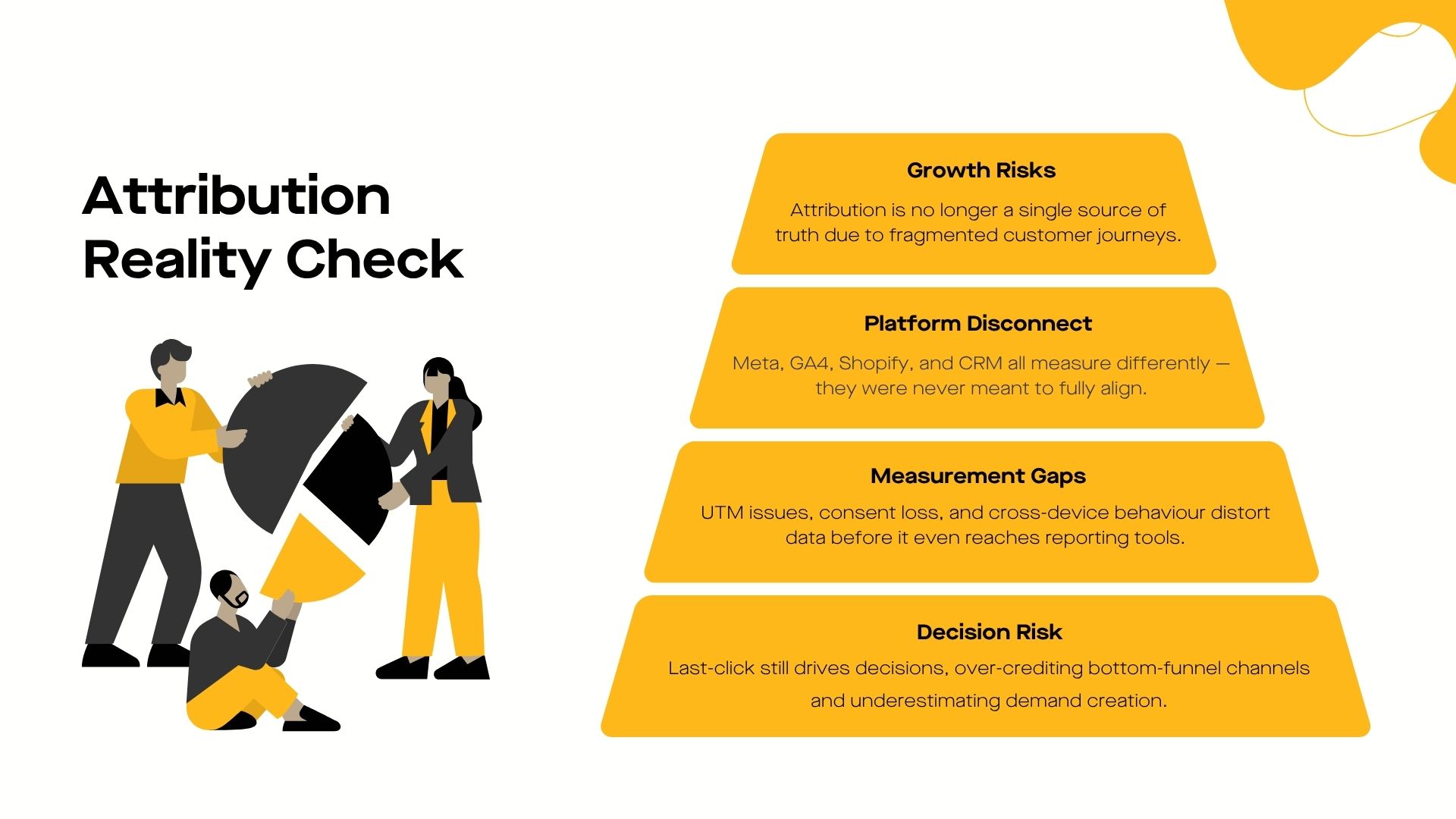
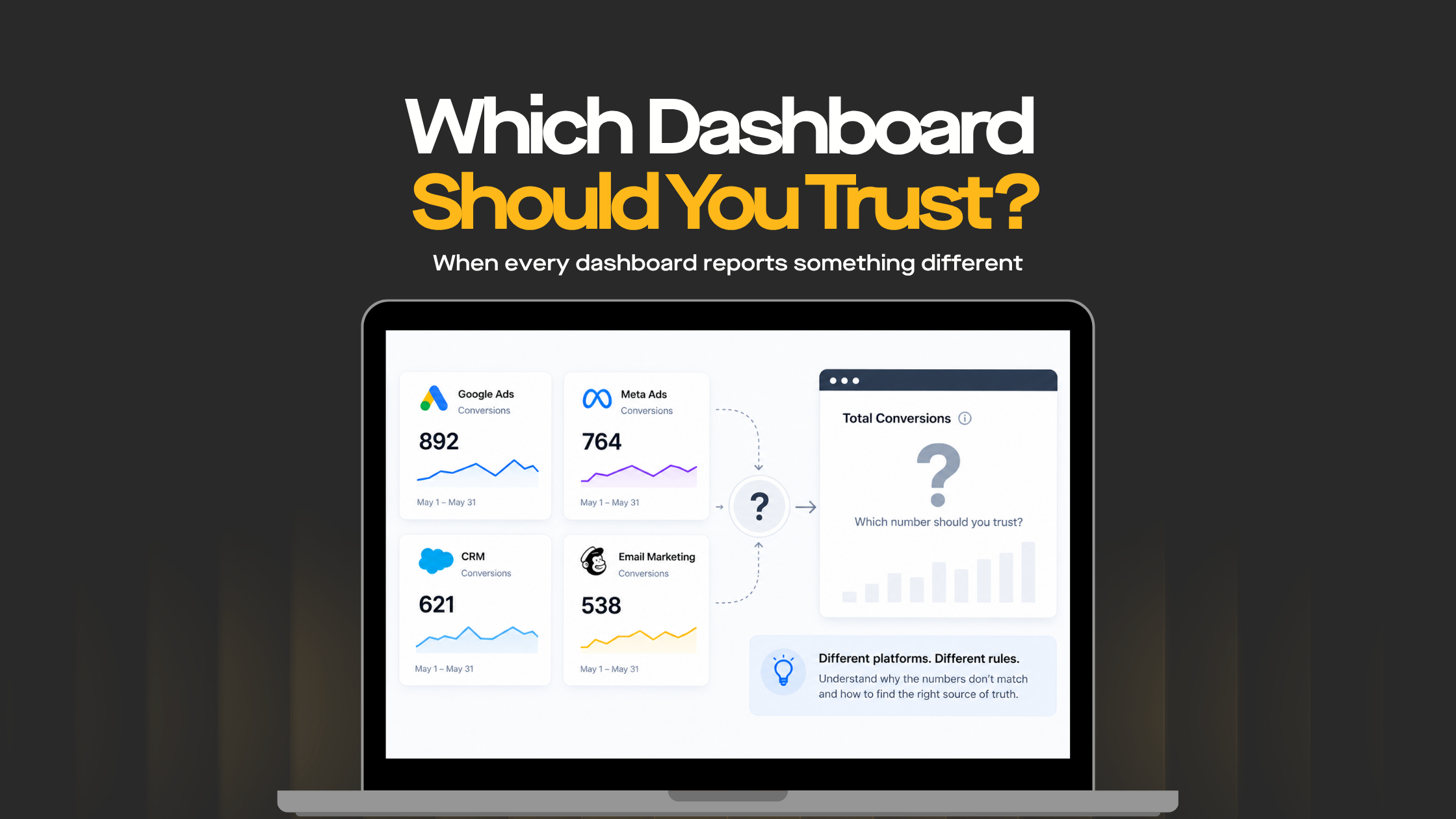
There might be chances that you run an ecommerce business today, you have probably experienced some version of the same conversation. Meta reports one number for conversions, whereas GA4 reports for another, Shopify tells a different story altogether, and it takes time for someone to ask who is actually telling the truth.
And it is definitely a reasonable question, but often a wrong one.
The reality is that it has become one of the most misunderstood areas of modern ecommerce measurement.
There are many businesses that think that if tracking is configured correctly, every platform should eventually produce the same answer. When that does not happen, teams often conclude that something is broken.
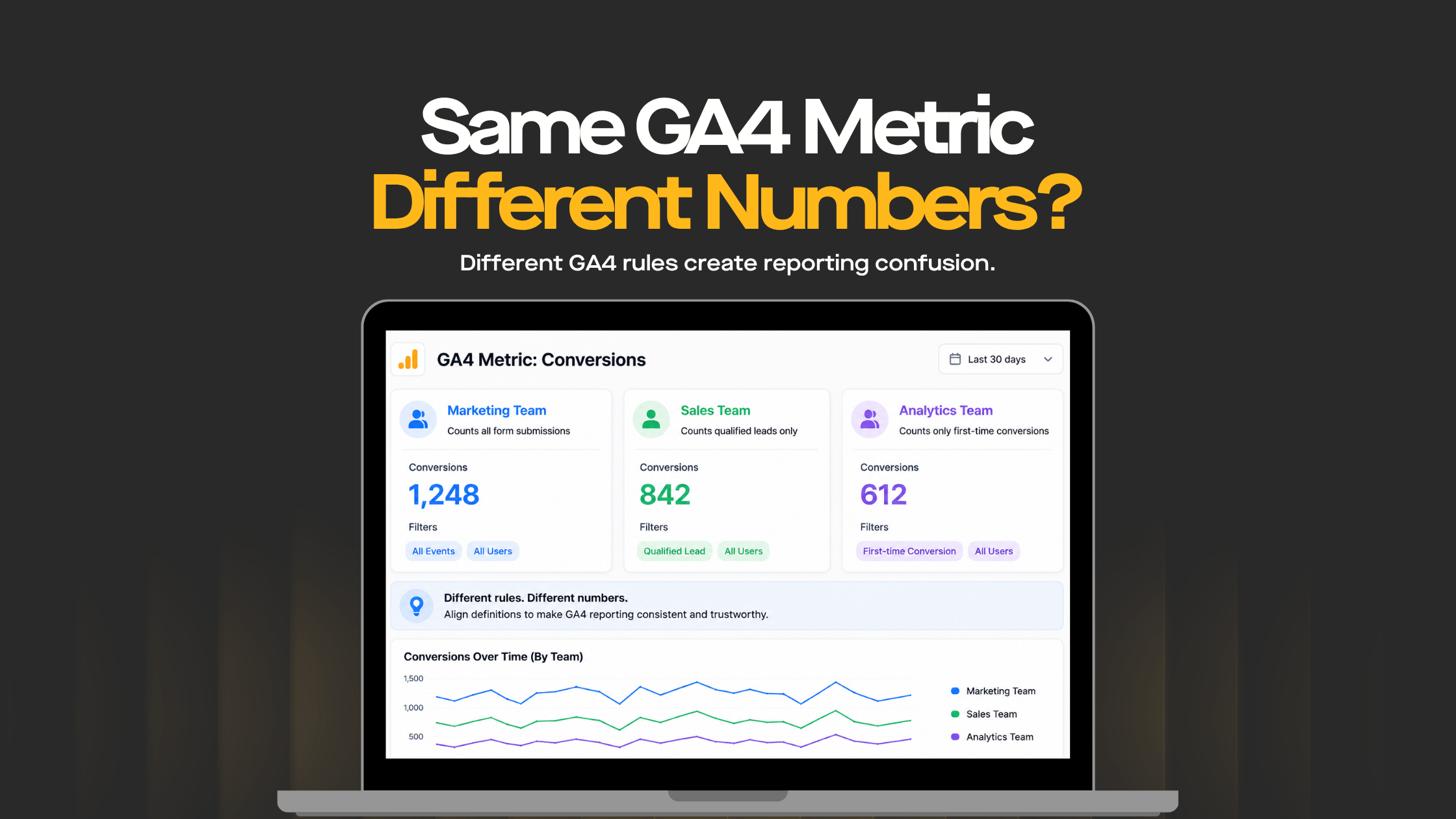
The challenge is that attribution was never designed to provide a single, universally accepted version of reality. Every platform measures customer behaviour from a different perspective, uses different identity signals, and applies its own attribution logic. What appears to be a reporting problem is often a reflection of how modern customer journeys actually work.
The ecommerce brands making better decisions in 2026 are not spending their time trying to force every number into alignment. Instead, they are building measurement frameworks that remain useful even when attribution is incomplete.
1. Why Attribution Feels More Difficult Than Ever
Attribution has been always about assumptions, but for so many years those assumptions were easier to ignore. Customer journeys were shorter, third-party cookies were widely available, and tracking systems had more visibility into user behaviour across devices and channels.
Today’s environment looks very different.
Consumers move from mobile apps, social platforms, browsers, email campaigns, search engines, physical locations, to market places before they make a purchase. Privacy regulations have decreased the amount of observable behaviour available to marketers, while consent requirements and browser restriction have introduced additional gaps into the customer journey.
As visibility decreases, platforms increasingly rely on modelling and inference to fill those gaps. The result is that different systems often tell different stories about the same conversion because each platform is working with a different set of signals.
What many businesses describe as attribution becoming worse is often attribution becoming more transparent about its limitations.

2. The Real Goal of Attribution Has Changed
For years, attribution was treated as a scoring system. Marketers wanted to know exactly which channel generated a sale so that budgets could be allocated accordingly. While that approach worked reasonably well in simpler digital environments, it has become increasingly difficult to apply in modern ecommerce.
Today’s customer journeys rarely follow a linear path. A customer may discover a product through social media, return later through organic search, sign up for email updates, click a retargeting ad, and eventually purchase after searching directly for the brand. Assigning all credit to a single touchpoint provides a neat answer, but it rarely reflects how the decision was actually made.
As a result, the role of attribution is evolving.
Rather than attempting to identify one definitive cause for every conversion, attribution is becoming a tool for understanding patterns, identifying channel influence, and supporting better decision-making. The objective is no longer perfect accuracy. The objective is useful insight.
Businesses that understand this distinction tend to make faster and more confident marketing decisions because they are not waiting for a level of certainty that modern measurement systems cannot provide.
3. Why Last-Click Attribution Continues to Create Problems
Although most marketers recognise that customer journeys involve multiple touchpoints, many ecommerce decisions are still influenced by last-click attribution.
3.1 Why Last-Click Attribution Can Be Misleading
- The final touchpoint receives most of the creditEven though customers often interact with multiple channels before making a purchase.
- Channels closest to conversion appear more effectiveBranded search, email marketing, retargeting campaigns, and direct traffic often receive disproportionate credit because they are typically the last interaction before a sale.
- Awareness-building channels are frequently undervaluedSocial media, content marketing, influencer campaigns, and display advertising help create demand but often receive little attribution credit.
- Marketing budgets can become unbalancedTeams may increase investment in channels that capture existing demand while reducing spend on channels that generate new demand.
- Short-term performance can look strongConversion-focused channels continue driving sales, making results appear healthy in attribution reports.
- Long-term growth can become harder to sustainAs investment in awareness and acquisition activities decreases, fewer new customers enter the funnel, increasing customer acquisition costs over time.
3.2 Why Better Tracking Does Not Solve Attribution
Server-side tracking is often promoted as a solution to attribution challenges, but its impact is frequently misunderstood.
- It improves data collection quality:
Reducing reliance on browser-based tracking and recovering signals that may otherwise be lost helps in improving data collection quality.
- It does not make platforms agree:
Once data enters Meta, Google Ads, GA4, Shopify, or a CRM, each platform applies its own attribution rules and measurement logic.
- Every platform sees the customer journey differently:
Which means reporting differences can still exist even with cleaner data.
- Better inputs do not create a single source of truth:
Improved tracking increases data accuracy, but it does not unify how platforms interpret conversions.
- Reporting discrepancies are still normal:
Attribution models, identity matching, and conversion windows vary across systems, so reporting discrepancies are still normal.
3.3 The key takeaway
Server-side tracking improves the quality of the data being collected, but it does not solve attribution itself. It helps businesses capture more accurate signals, while the differences between platforms remain largely unchanged.
4. A Better Ecommerce Measurement Framework
The most effective ecommerce teams have stopped searching for a single source of truth. Instead, they use different systems for different purposes and combine multiple signals to understand performance.
Platform reporting remains valuable for optimisation. Meta is best positioned to help optimise Meta campaigns, and Google Ads is best positioned to optimise Google campaigns. While platform reporting may not provide a complete picture, it offers the fastest feedback loop for improving campaign performance.
GA4 is most useful for understanding customer behaviour and identifying trends. It helps businesses understand how users interact with websites, where friction exists in the customer journey, and which channels contribute to engagement over time.
Attribution can help explain which channels influenced a purchase, but it does not always reveal why some visitors convert while others leave. An experienced CRO agency can combine GA4 behavioural data, funnel analysis and structured experimentation to identify onsite friction and test improvements across product pages, cart and checkout.
Shopify and backend commerce systems serve a different purpose. They provide transaction truth. While attribution platforms attempt to explain why a purchase occurred, ecommerce platforms record the purchase itself. Revenue discussions should always begin with the systems that record actual transactions.
The strongest measurement programmes combine these perspectives rather than treating any one of them as the definitive answer.
5. Why Incrementality Matters More Than Attribution
One of the most important shifts happening in ecommerce measurement is the growing focus on incrementality.
Attribution tells us which marketing activities appeared in the path to conversion. Incrementality asks a more important question: would the conversion have happened without the marketing activity?
This distinction matters because many channels perform exceptionally well in attribution reports while contributing less incremental value than expected. Retargeting campaigns are a common example. They often receive significant attribution credit because they appear close to conversion, but some of those customers may have converted regardless of whether the ad was shown.
Conversely, awareness campaigns frequently receive limited attribution credit despite playing an important role in generating future demand.
This is why more sophisticated ecommerce businesses are investing in holdout testing, geo experiments, lift studies, and controlled testing methodologies. These approaches are not perfect, but they provide a stronger understanding of causality than attribution alone.
For Adelaide-based ecommerce businesses, working with a CRO agency in Adelaide can help turn attribution insights into controlled conversion experiments. This may include testing landing-page experiences, product journeys, offers or checkout changes to understand which improvements generate genuinely incremental revenue.
6. Attribution Is Now a Business Problem, Not Just a Marketing Problem
As attribution becomes more complex, the consequences extend well beyond the marketing team.
Finance teams become less confident in channel reporting. Leadership teams struggle to reconcile conflicting performance narratives. Marketing teams spend increasing amounts of time defending numbers rather than improving results.
What begins as a measurement challenge can quickly become an organisational challenge. Different departments start operating from different versions of reality, making alignment and decision-making more difficult.
The businesses navigating this successfully are not necessarily those with the most advanced technology stacks. They are the ones that establish shared expectations about what attribution can and cannot tell them.
When everyone understands the limitations of measurement, conversations become more productive and decisions become easier to make.
7. The Future of Ecommerce Attribution
As customer journeys become more fragmented and privacy restrictions continue to grow, attribution will become less about finding exact answers and more about identifying reliable growth signals.
8. Why the Future of Attribution Will Be Multi-Signal
- Perfect attribution is unlikely to existAs customers interact with more platforms, devices, and channels, journeys will continue to become more fragmented.
- Privacy changes will reduce tracking visibilityMaking it harder to observe and connect every step of the customer journey.
- AI-driven search and new commerce experiences will add complexityTraditional attribution models will struggle to fully capture these emerging behaviours.
- Businesses will rely on multiple data sourcesRather than depending on a single platform to explain performance.
- Attribution will become one signal among manyAlongside analytics, revenue data, customer research, cohort analysis, and experimentation.
- Decision-making will shift toward patterns and trendsRather than focusing on explaining every individual conversion.
- The goal will move away from tracking every saleToward understanding what consistently drives long-term growth.
9. FAQs
Q. Why don’t Meta, GA4 and Shopify numbers match?
A. Because each platform measures customer behaviour differently. They use different attribution windows, identity systems, tracking methods, and reporting logic. Differences between platforms are expected and often unavoidable.
Q. Is GA4 still useful for ecommerce attribution?
A. Yes. GA4 is valuable for understanding customer behaviour, identifying trends, and analysing user journeys. However, it should not be treated as a complete source of truth for attribution.
Q. Does server-side tracking improve attribution?
A. Server-side tracking improves data collection quality and helps recover lost signals, but it does not eliminate reporting differences between platforms because each platform interprets data differently.
Q. What is incrementality?
A. Incrementality measures whether marketing activity actually influenced an outcome. Instead of asking whether a channel appeared in the conversion path, it asks whether the conversion would have happened without that marketing activity.
Q. How should ecommerce businesses approach attribution today?
A. Focus on building a measurement framework rather than chasing a perfect attribution model. Use platform reporting for optimisation, analytics platforms for behavioural insights, ecommerce systems for revenue validation, and experimentation for understanding causality.

Recent Posts

Case Studies
Business News Australia
On Track Meals
Suncorp