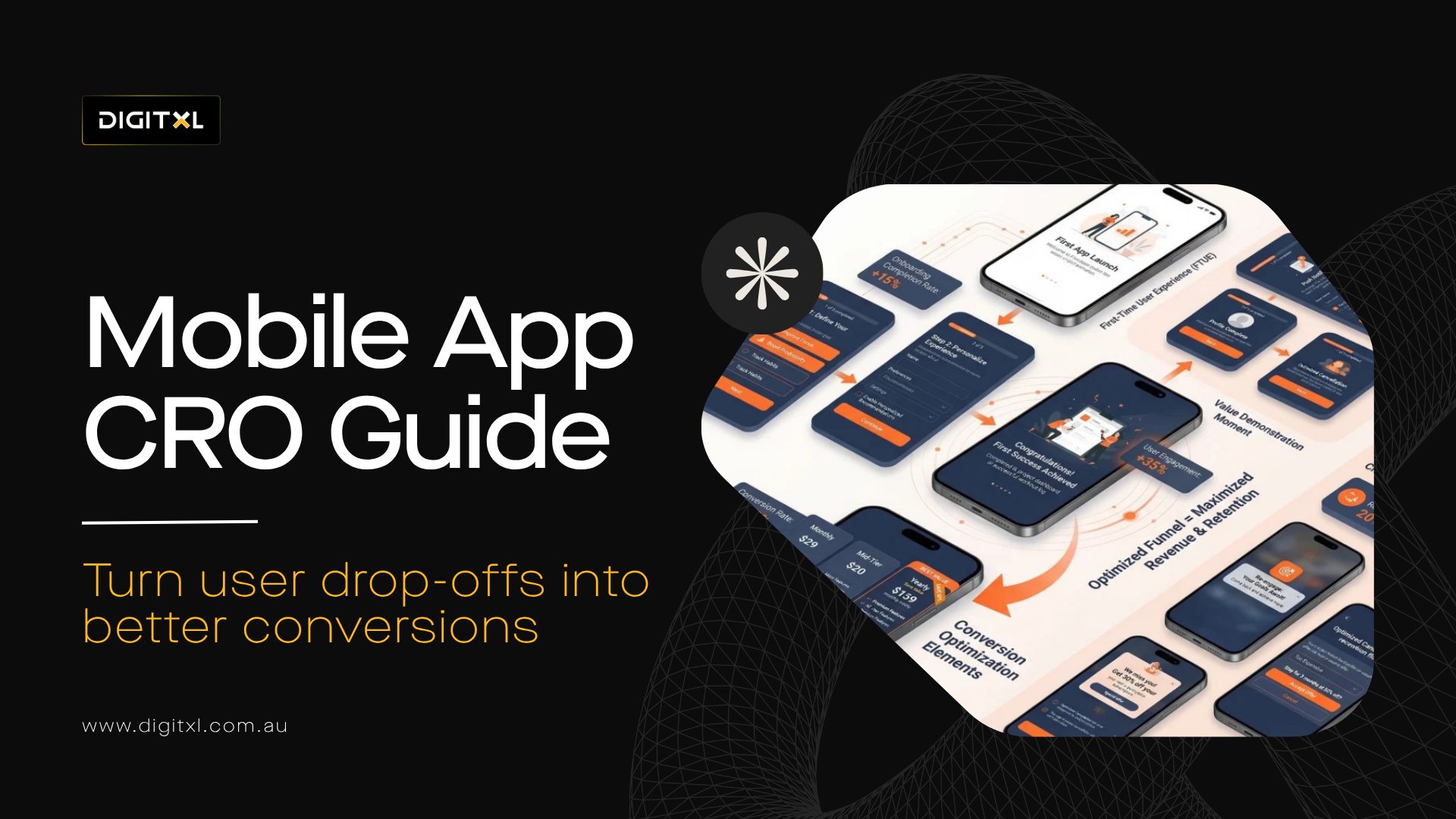
1. How Do You Improve Your App Conversion Rate?
You improve your app conversion rate by measuring the full conversion funnel. You identify where users drop off. You reduce friction. You improve onboarding. You fix technical issues. You test key screens. You connect app behaviour to revenue, leads, or retention.
A strong App Conversion Rate Optimisation program usually includes:
- App analytics and Google Analytics setup
- Analytics Configuration and event tracking
- Funnel analysis
- User journey analysis
- UX reviews
- Session recordings and heat maps
- Product discovery review
- Checkout flow optimisation
- A/B testing and multivariate testing
- Landing page optimisation for app campaigns
- Performance reporting across app, website, CRM and paid media
The goal is simple: help more of the right users complete the actions that create business value.
2. What Is Mobile Apps CRO?
Mobile Apps CRO is the process of improving how users move through a mobile app and complete important actions.
These actions may include creating an account, completing onboarding, making a first purchase, booking an appointment, starting a trial, upgrading to a paid plan, submitting a form, redeeming an offer, or returning for a repeat session.
The conversion depends on the type of digital product.
|
App Type |
Key Conversion Goal |
|---|---|
|
Ecommerce app |
Product page view to purchase |
|
Food or QSR app |
Menu view to order |
|
Healthcare app |
Appointment booking |
|
SaaS app |
Trial start to paid upgrade |
|
Finance app |
Application completion |
|
Loyalty app |
Offer redemption or repeat purchase |
|
Marketplace app |
Search to enquiry or transaction |
Good app CRO starts by defining the right conversion goals. Without that, teams may optimise screens without improving the metric that actually matters.
3. Why App Conversion Rate Optimisation Matters
Many teams focus on app installs, website traffic, website visitors, click-through rate and campaign reach. These can be useful signals, but they can also become vanity metrics if users do not convert.
If users install the app but do not activate, buy or return, your marketing spend becomes less efficient because you are paying to bring people into a journey that is not converting. This affects ad spend, digital acquisition costs, customer acquisition costs, campaign performance and the overall return from your wider marketing strategies. For example, your Google Ads, Paid Ads, Facebook ads, social media campaigns or email activity may be doing their job by driving app installs, but if users drop off during onboarding, abandon checkout or never reach the first value moment, the problem is not only acquisition. It means there is a gap between the promise that brought users into the app and the experience they receive once they arrive. In that situation, increasing ad spend may only bring more users into the same broken journey. A stronger approach is to review the full path from campaign message to landing page, app store listing, first open, onboarding, activation and conversion, so you can identify whether the issue is traffic quality, user experience, offer clarity, trust signals or the app conversion funnel itself. It means the app experience, conversion funnel and lifecycle journey are not turning interest into business value. Over time, this can make campaigns look more expensive, reduce confidence in digital marketing performance and limit growth even when traffic volume appears healthy.
Common app conversion problems include:
- High installs but low account creation
- Users dropping off during onboarding
- Cart abandonment inside the app
- Product pages getting views but not purchases
- Trial users not becoming paid subscribers
- Booking flows being started but not completed
- Push notifications failing to bring users back
- Poor visibility across app, website and CRM journeys
These problems are not always design issues. Sometimes the problem is analytics. Sometimes it is traffic quality. Sometimes it is poor UX design, weak trust signals, unclear content strategy, technical performance, slow page speeds, or a disconnect between the marketing campaign and the app experience.
That is why App Conversion Rate Optimisation should involve analytics, CRO, digital marketing, UX, development, customer support, and product strategy.
3.1 Start With the App Conversion Funnel
Do not start by guessing which app screen needs design amendments. Start by mapping the full conversion funnel so you can see where users enter, where they continue, and where they drop off. This helps your team avoid making changes based on opinion and instead focus on the parts of the journey that are actually limiting conversion rate. For example, the issue may not be the product page design. It may be onboarding, login friction, poor campaign traffic quality, checkout flow issues or missing trust signals. Funnel mapping gives you the evidence needed to prioritise the right fixes first.
A basic mobile app conversion funnel may include install, first open, onboarding, registration, activation, core conversion, retention and revenue.
|
Funnel Stage |
What to Measure |
|---|---|
|
App install |
Installs by source, campaign and platform |
|
First open |
Whether users open the app after install |
|
Onboarding |
Step-by-step completion rate |
|
Registration |
Starts, errors and completions |
|
Activation |
First meaningful action |
|
Core conversion |
Purchase, booking, lead or subscription |
|
Retention |
Repeat sessions and returning users |
|
Revenue |
Purchase value, subscription value or lead value |
This helps answer practical questions:
- Are we attracting the right users?
- Are users reaching the first value moment?
- Where is the largest drop-off?
- Which campaigns drive users who actually convert?
- Which user journeys create revenue or qualified leads?
Without funnel analysis, app CRO becomes guesswork.
3.2 Fix Analytics Before Testing
You cannot improve conversion metrics properly if the measurement is unreliable.
Before starting A/B testing, check whether your app analytics setup is trusted. Key events should fire correctly, event names should be consistent, important parameters should be included, campaign sources should be captured, and app journeys should connect with website, CRM and backend data where needed.
For ecommerce apps, this may include product views, product detail pages, add to cart, begin checkout, purchase value, currency and transaction ID.
For lead generation apps, this may include form start, form submit, appointment booked, quote requested or application completed.
A CRO agency should not start testing app screens until the measurement layer is reliable. Otherwise, test results may look useful but be based on incomplete, inconsistent or misleading data. If key events do not fire correctly, conversion goals are unclear, or app activity is not linked with Google Analytics, CRM data, or paid media sources, the team may optimize the wrong part of the journey. A test might appear to improve click-through rate or screen engagement, but still have no real impact on purchases, bookings, subscriptions or lead quality. Before running A/B testing or design changes, you should first make sure the analytics setup, event tracking, attribution, and reporting are accurate. This helps support confident decisions.
Digitxl’s strength is connecting Google Analytics, CRO, experimentation, customer behaviour, and performance reporting. This helps app teams make decisions with confidence.
3.3 Review Onboarding and First Value
Onboarding is one of the most important app conversion points.
Many users decide whether an app is useful within the first few minutes of opening it. If onboarding is too long, too vague or too demanding, users may leave before they experience the value that made them download the app in the first place. This often happens when an app asks users to create an account, allow notifications, share location, complete a profile or verify details before showing them what they can actually do. A stronger onboarding journey should reduce unnecessary steps, explain the benefit clearly and guide users towards one meaningful first action as quickly as possible.
Review whether:
- Registration is required too early
- Users are asked for too many permissions
- Verification is causing friction
- Users can skip non-essential steps
- The first value moment is clear
- Visual hierarchy makes the next step obvious
- Call to actions are easy to understand
A common mistake is asking for too much too soon. Users may not want to create an account, allow notifications, share location and complete a profile before they understand what the app gives them.
The better approach is to guide users towards one meaningful first action.
3.4 Reduce Friction in the Main Conversion Path
Mobile users have less patience for friction.
Small issues can create large conversion problems. These problems may include slow screens, unclear call to action buttons, too many form fields, weak error messages, confusing navigation, payment failures, broken deep links, login loops, or unclear pricing and delivery information.
For ecommerce apps, review product discovery, product pages, cart and checkout flow.
For service apps, review booking flows, enquiry forms and quote requests.
For subscription apps, review trial messaging, paywalls, pricing screens and upgrade prompts.
If you also run campaign landing pages before sending users to the app, review those as part of the same conversion journey. A landing page may generate strong website traffic from Google Ads, Paid Ads, social media, or email campaigns. However, it can still produce poor app installs, low first-open rates, or weak activation if the message does not match the app experience. For example, users may click because the offer sounds relevant, but drop off if the landing page has unclear hero messaging, weak trust signals, slow page speeds, confusing call to actions or too many steps before the app download. The same issue can happen when the landing page promises one benefit, but the first app screen asks users to register, allow permissions or complete setup before showing that value. In this case, the problem is not only the app. The issue sits across the full campaign-to-app journey.
The question to ask is simple: what is stopping users from completing the next step?
3.5 Improve Product Pages and Product Discovery
For ecommerce apps, Product discovery is often where conversion rate improvement starts.
Users need to find the right product quickly, understand the value and feel confident enough to add to cart.
Review:
- Search and filters
- Category navigation
- Product Page layout
- Product detail pages
- Product images
- Reviews and trust signals
- Delivery and returns information
- Add-to-cart visibility
- Related products
- Personalised recommendations
For Shopify or ecommerce brands, app CRO should also align with the broader Shopify e-commerce strategy. If the website, app, paid ads and email journeys show different offers or messages, the customer journey can feel disconnected.
3.6 Use A/B & Multivariate Testing Carefully
App experimentation should be structured, not random.
Many businesses already use website experimentation to improve conversion rates, customer journeys and digital performance, but they do not always apply the same testing discipline to their mobile app. This creates a significant opportunity to introduce a structured, hypothesis-led experimentation program across key app experiences, including onboarding, checkout, product pages, push notifications and lifecycle journeys. Teams can understand what affects user behaviour better by testing changes step by step instead of guessing. This reduces problems and shows which improvements most help activation, engagement, retention, and revenue. Applying the same rigorous approach used in website CRO can help businesses make more confident decisions and continuously improve the mobile app experience.
|
Problem |
Hypothesis |
Test |
|---|---|---|
|
Users drop off during onboarding |
Shorter onboarding will increase activation |
Test 5-step vs 3-step onboarding |
|
Trial starts are low |
Clearer hero messaging will improve starts |
Test pricing screen copy |
|
Cart abandonment is high |
More payment options will improve purchases |
Test alternative payment option |
|
Users do not return |
Better lifecycle timing will improve retention |
Test push timing and message |
|
Form completion is low |
Shorter form will increase submissions |
Test reduced-field form |
An A/B testing platform or testing platform should be used when there is enough traffic, a clear hypothesis and proper Quality Assurance. For larger apps, multivariate testing may help compare combinations of copy, layout, offers and call to actions.
The aim is not to run more tests for the sake of testing velocity. The aim is to create incremental CRO gains that improve revenue, leads, retention or market share over time.
3.7 Use Behaviour Tools to Find Friction
Analytics can show where users drop off. Behaviour tools can help explain why.
Use:
- Session recordings
- Heat maps
- Heatmap analysis
- Scroll depths
- Tap and click behaviour
- Error tracking
- User journey analysis
- Customer support feedback
For apps and landing pages, these tools can reveal whether users are missing CTAs, ignoring important content, getting stuck in forms or abandoning checkout because something feels unclear.
This analysis should be supported by customer research, competitor research and broader market research. Reviewing website behaviour alone may show where users are dropping off, but it does not always explain why the friction exists or what customers expect instead. Customer research can uncover motivations, concerns and decision-making barriers, while competitor and market research can reveal changing expectations, industry benchmarks and potential gaps in the experience. CRO becomes much stronger when behavioural data is combined with this wider context, allowing teams to make more informed decisions and prioritise improvements that are both user-focused and commercially relevant.
3.8 Connect App CRO With Retention and Lifecycle Marketing
App conversion is not only about the first action.
For many apps, long-term value comes from repeat behaviour. Track Day 1, Day 7 and Day 30 retention, repeat purchases, subscription renewals, feature adoption, churn points and lifetime value.
Lifecycle marketing can support App Conversion Rate Optimisation through:
- Push notifications
- In-app messages
- Email Campaign Optimisation
- SMS journeys
- Personalised offers
- Abandoned cart recovery
- Win-back campaigns
- Social media retargeting
But these messages need to be useful, relevant and delivered at the right moment. Well-timed notifications can remind users about important actions, highlight genuine value and encourage them to return to the app. However, sending too many messages or sending them without considering the user’s behaviour, preferences or stage in the customer journey can quickly become intrusive. This may reduce brand trust, increase notification opt-outs and, in some cases, lead users to uninstall the app altogether.
3.9 Do Not Ignore Technical and Web Performance
Technical quality can quietly damage app conversion.
Review app crashes, slow screens, app not responding errors, payment errors, broken deep links, poor login performance, API delays, app size and version-specific bugs.
For campaign landing pages and web-to-app journeys, web performance should also be reviewed as part of the CRO process. A user may never reach the app if the landing page is slow, unstable or difficult to use on mobile. Issues such as JavaScript CLS, LCP image processing problems, slow page speeds, poor mobile rendering or delayed call to action buttons can reduce conversion before the app journey even begins. This is why mobile app CRO should not only assess the app itself, but also the landing pages, campaign paths and technical performance that influence whether users install, open and activate.
A proper CRO process should include Quality Assurance, web performance checks and page speed review before and after important tests or launches.
If the app or landing page is slow, unstable or unreliable, users are less likely to convert.
4. What Should You Fix First in Mobile App CRO?
Not every issue should be fixed at once. Prioritise the parts of the journey where users are actually dropping off and where improvement will have the biggest impact on conversion rate, revenue, bookings or lead quality. For example, if most users abandon during onboarding, changing the checkout screen will not solve the main problem. If users reach the product page but do not add to cart, the issue may sit with product discovery, trust signals, pricing clarity, visual hierarchy or call to action buttons. A strong Mobile Apps CRO process uses funnel analysis, user behaviour data, session recordings and conversion metrics to identify the highest-impact fixes first, instead of spreading effort across too many low-value changes.
|
If This Is Happening |
Fix This First |
|---|---|
|
Users install but do not open |
Review traffic quality and app store promise |
|
Users open but do not onboard |
Simplify onboarding and first-use experience |
|
Users onboard but do not activate |
Improve first value moment |
|
Users browse but do not convert |
Review product discovery, CTAs and offer clarity |
|
Users start checkout but abandon |
Fix payment, delivery, form and trust friction |
|
Users convert once but do not return |
Improve lifecycle messaging and retention |
|
Reports are unclear |
Fix analytics, events and attribution first |
For most businesses, the best sequence is to fix analytics first. Then identify the biggest funnel drop-off. Review onboarding and fix technical blockers. Improve the main conversion path. Test one high-impact change. Connect conversion to retention and revenue.
5. App CRO Metrics to Track
A practical app CRO dashboard should combine acquisition, behaviour, conversion and retention data.
|
Metric |
Why It Matters |
|---|---|
|
Install to first open rate |
Shows whether users start after install |
|
Onboarding completion |
Shows early friction |
|
Activation rate |
Measures first meaningful action |
|
Checkout or form conversion rate |
Measures core business outcome |
|
Revenue or lead value |
Connects CRO to commercial impact |
|
Retention rate |
Shows whether users come back |
|
Cart abandonment |
Identifies checkout or buying friction |
|
Session recordings and heat maps |
Help explain user behaviour |
|
Campaign source |
Connects acquisition to user quality |
|
Experiment result |
Shows which changes worked |
For leadership, the dashboard should answer whether the app is becoming easier to use, more valuable to users and more profitable for the business.
6. Common Mobile Apps CRO Mistakes
Common Mobile Apps CRO mistakes include measuring installs but not activation, treating click-through rate as success, testing screens without reliable analytics, asking for too many permissions too early, and ignoring app store or landing page optimisation. Teams also often use push notifications without a clear value exchange, measure first conversion but ignore retention, or run tests without a clear hypothesis. These mistakes usually happen when the app is treated as a finished product rather than an ongoing customer journey that needs regular measurement, testing and improvement.
These mistakes happen when teams treat the app as a finished product rather than an ongoing conversion journey.
7. How a CRO Agency Can Help
Businesses often bring in a CRO agency when app installs are increasing but conversion rate is flat or declining.
For app-focused work, conversion rate optimisation consulting may include:
- Analytics Configuration
- Funnel analysis
- UX reviews
- Heatmap analysis
- Session recording review
- App store and landing page optimisation
- A/B & Multivariate Testing
- Checkout flow optimisation
- Customer research
- Performance reporting
- Design amendments and Quality Assurance
- End-to-end experimentation programmes
At Digitxl, this work connects analytics, CRO, experimentation, martech, digital marketing and customer journey analysis into one optimisation process. Better app conversion rarely comes from one isolated screen change. It comes from understanding the full sales funnel, identifying where users lose confidence or momentum, improving the user experience, and measuring whether those changes create a real commercial impact. That means looking beyond surface-level engagement and focusing on the outcomes that matter, such as completed purchases, bookings, subscriptions, qualified leads, retention and revenue.
This approach can support an in-house team that needs specialist CRO support, stronger testing platforms, better reporting or a clearer experimentation roadmap.
A strong Mobile Apps CRO program should help answer:
- Where are users dropping off?
- Which journeys are creating value?
- Which campaigns bring users who convert?
- Which screens need testing first?
- Which changes improve revenue, leads or retention?
- Can the business trust the app conversion data?
That is the difference between guessing and optimising properly.
8. Why Mobile Apps CRO Is Crucial for Business Growth
Mobile Apps CRO is becoming more important as businesses invest more in apps, paid acquisition, ecommerce, digital products and customer retention.
Improving your app conversion rate starts with measurement. You need to know where users come from, where they drop off, what they complete and what prevents them from taking the next step.
From there, focus on the highest-impact areas. These include onboarding, product discovery, checkout flow, forms, technical quality, lifecycle messaging, and experimentation.
The strongest Conversion Rate Optimisation for Apps programs are not based on guesswork. They combine Google Analytics, user experience, customer behaviour, A/B testing, content strategy and business strategy.
For marketing and product teams, the question should not only be, “How do we get more installs?”
The better question is:
“How do we help more of the right users complete the actions that create value?”

 Previous