1. Step 1: Map the Customer Journey Using Real Behaviour Data
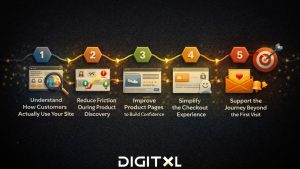
The biggest disconnect in most businesses sits between assumed behaviour and actual user behaviour.
A structured approach should include:
- Analysing conversion funnel paths across sessions
- Tracking drop-offs using funnel tracking and heat mapping / heatmap analysis
- Understanding how mobile devices and desktop journeys differ
This is critical to improving conversion rates, as most drop-offs happen between stages rather than on a single page.
What this uncovers:
- Hidden friction causing high bounce rate and bounce rates
- Poor customer experience across devices
- Gaps between website traffic acquisition and conversion
2. Step 2: Optimise Landing Pages Based on Intent
Many businesses drive traffic effectively but fail at landing page optimisation.
Common issues:
- Generic messaging across all traffic sources
- Weak visual hierarchy and unclear CTAs
- Lack of alignment between paid media campaigns such as Google Ads and the landing experience
Strong landing pages should:
- Match the intent of the target audience
- Provide clarity through structured website design
- Use product images and product descriptions to reinforce value
This is a foundational B2C Conversion Rate Optimisation tip : align message, intent, and experience at entry.
3. Step 3: Strengthen Product Pages and Trust Signals
Conversion hesitation often happens at the product level, not just at the checkout.
Key gaps:
- Weak product pages and product detail pages
- Missing or generic customer reviews
- Lack of clear trust signals such as SSL certificates, guarantees, and policy reassurance
Optimisation opportunities:
- Improve product details page clarity with structured content
- Add contextual customer reviews tied to real use cases
- Strengthen policies such as return policy and transparency
These improvements reduce decision friction and directly support conversion rate optimisation.
4. Step 4: Simplify the Checkout Process and Reduce Abandonment
The checkout process is where many revenue leaks occur, particularly when there is a high cart abandonment rate or rising abandonment rate.
Common friction points:
- Complicated checkout flow
- Limited payment methods
- Lengthy checkout form or poorly designed multi-step forms
What to fix:
- Add real-time validation to reduce avoidable errors
- Use progress bars to show completion stages
- Simplify the shopping cart and form flow
Additional improvements:
- Trigger abandoned cart messaging
- Prioritise mobile UX and mobile optimisation
This step is central to how to increase B2C conversion rates without relying on more media spend.
5. Step 5: Build a Structured Testing and Optimisation Framework
Sustainable growth comes from continuous testing, not isolated changes.
Core testing approaches:
- A/B testing, A/B tests, and split testing
- Advanced multivariate testing and multivariate experiments
- Behavioural insights from heat maps and user testing
Testing should focus on:
- Entry points from ads to landing experiences
- Mid-funnel behaviour and product engagement
- Checkout performance and form completion
Using CRO tools and testing software, businesses can systematically reduce revenue leaks and improve performance.
This is where working with a CRO Consultant, eCommerce CRO Agency, or specialist CRO Agency can be valuable. The same strategic discipline is also relevant in CRO for B2B business, where form friction, trust signals, and journey continuity influence lead quality and pipeline conversion.
6. Common Gaps That Limit B2C Conversion Performance
Even capable teams struggle because of:
- Disconnected digital marketing and content marketing activity
- Weak alignment between search ranking and page experience
- Inconsistent campaign monitoring across channels
- Limited use of brand surveys and post-purchase survey insights
These gaps lead to inconsistent customer journey experiences and missed commercial opportunities.
7. Broader Business Impact
Improving the customer journey does more than lift conversion rate. It also supports:
- Better acquisition efficiency
- Stronger brand loyalty and repeat purchase behaviour
- Better alignment between digital strategists and delivery teams
- Greater long-term customer value
For Sydney-based B2C businesses, working with a CRO agency in Sydney can help connect customer journey insights with a structured experimentation roadmap. This allows teams to prioritise improvements across acquisition landing pages, product journeys, trust signals and checkout based on their likely commercial impact.
8. Closing Perspective
The difference between average and high-performing B2C businesses lies in how well they connect each stage of the journey, from first click through to final purchase.
The real question is not whether optimisation is happening, but whether it reflects actual customer behaviour across the full funnel.
Worth testing?

 Previous