- CRO
CRO for Start Ups: Growth on a Tight Budget
26 Aug 2025
Startups burn fastest where no one is looking, which is the funnel. Founders obsess over ads, launches, and traffic spikes because they look impressive on a dashboard. Meanwhile, conversions crawl.
Traffic spikes look great on a pitch deck. But investors don’t fund traffic. They fund traction. And traction only happens when conversion holds. Even if you understand the concept of CRO, many startups delve into surface level testing which could be changing the banners, buttons, website look, etc.. but can’t pinpoint where the leaks are occurring and that’s often where a specialised CRO agency can change the picture.
That’s why conversion rate optimisation (CRO) is a survival discipline from the beginning.
1. Why CRO is Survival
Acquisition costs have climbed steeply. Meta and Google auctions are brutal and organic reach is throttled. Investors are asking harder questions about efficiency, not just visibility.
A startup that ignores CRO is paying twice. First for traffic, then for the people who leave without acting.
The importance of CRO for start ups comes down to this: when your budget is thin, every lost sign-up, trial, or checkout stings harder. Growth only happens if the funnel holds.
2. CRO Reality Check for Founders
Every industry has its own conversion blind spots. Run this against your business. If more than two answers come back shaky, more spend won’t solve it.
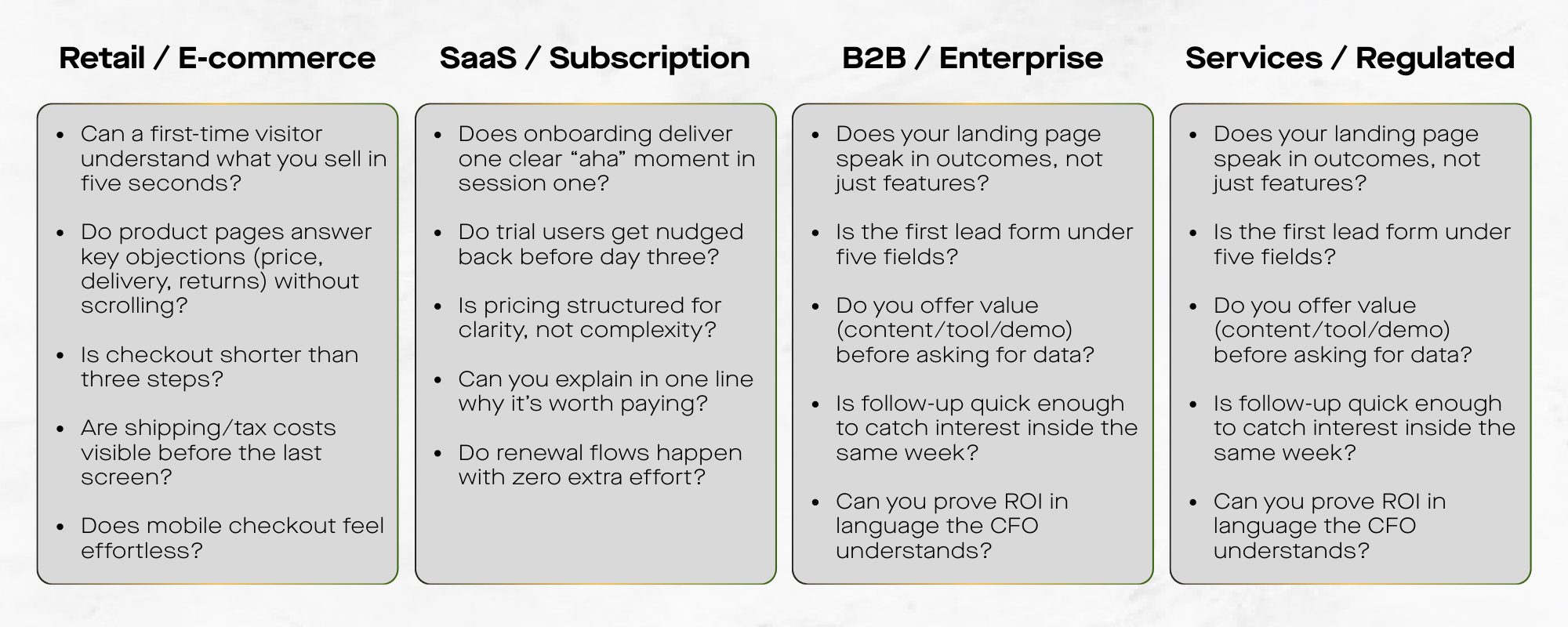
3. The Start Up Revenue formula
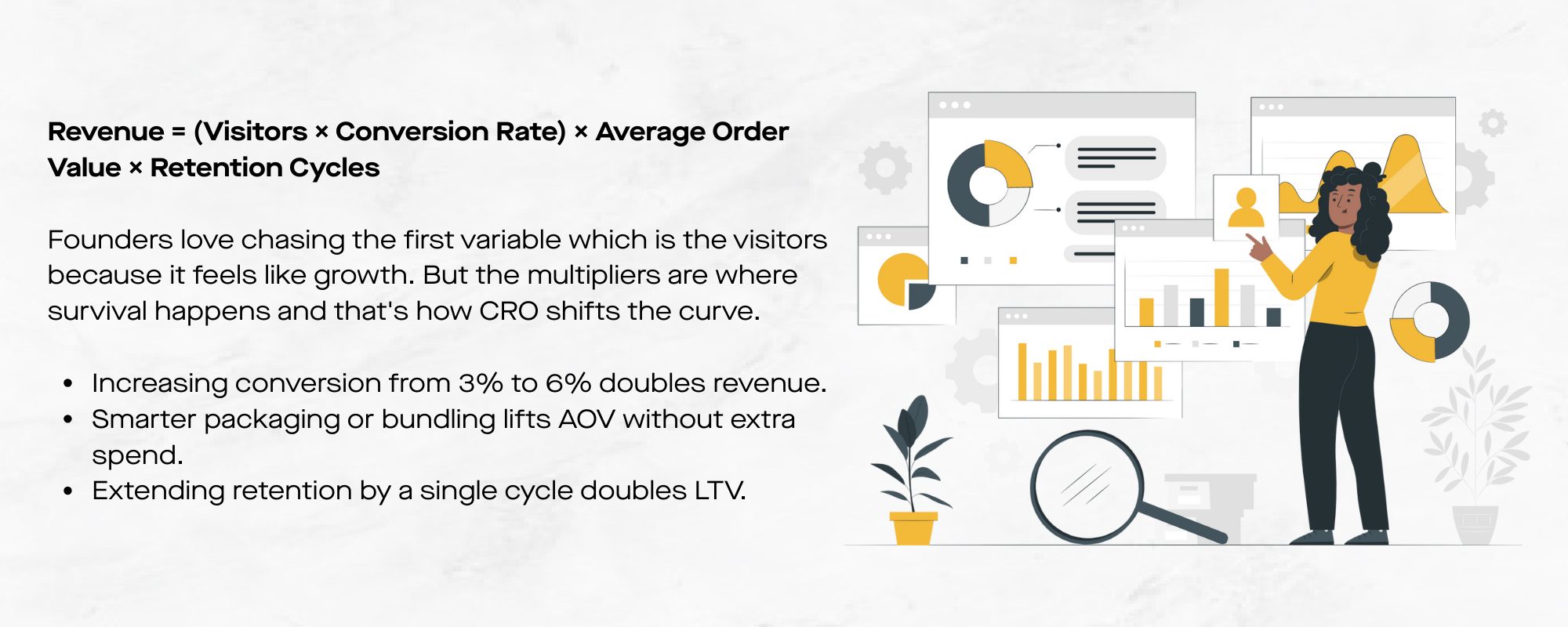
4. Where Start Ups Burn vs. Where CRO Saves
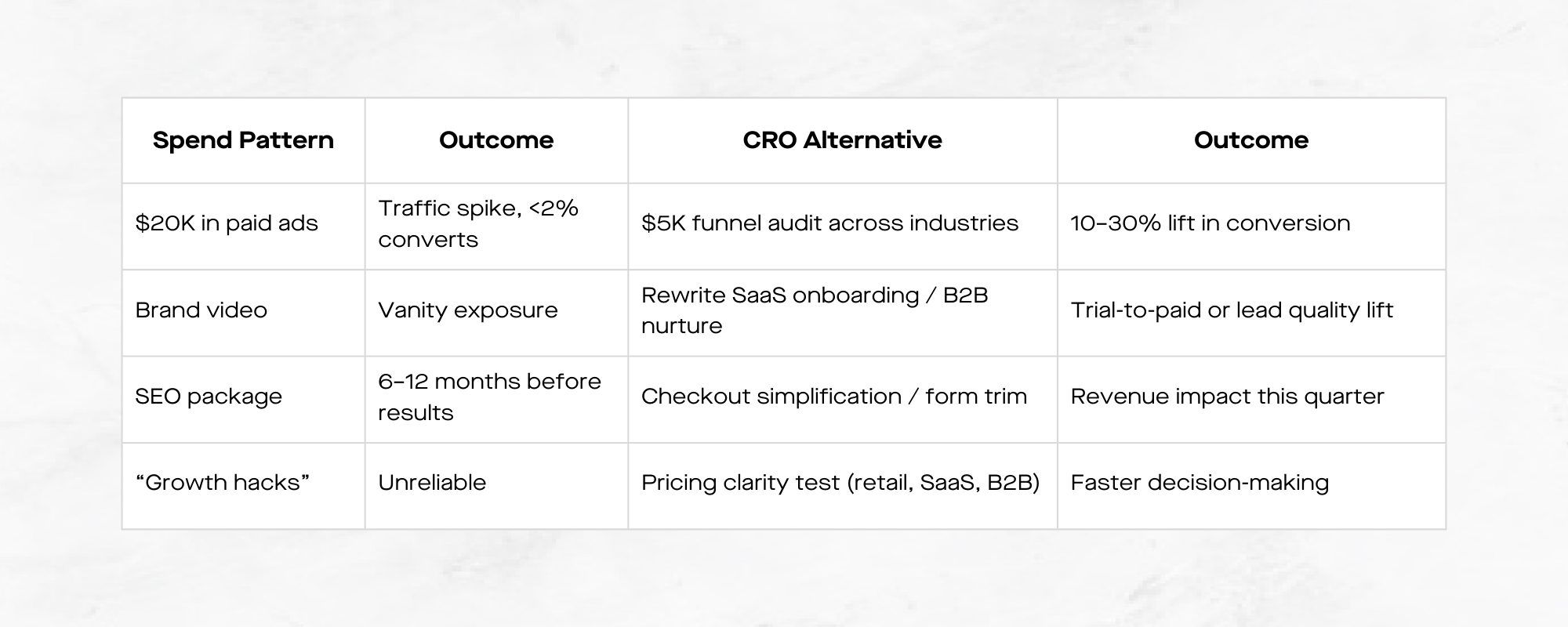
5. CRO Plays Under $1k
Optimisation is not always big rebuilds or big budgets. Some of the fastest wins cost almost nothing and they’re usually hiding in plain sight.
- Retail: Watch a handful of checkout recordings. You’ll see where people hesitate, click away, or give up. Fix one of those points and you’ll feel the lift straight away.
- SaaS: Adjust the billing toggle or send a single day-two nudge email. Tiny changes in default behaviour can shift activation and retention without touching acquisition spend.
- B2B: Shorten the demo form. Nobody needs twelve fields before a first call. Less friction means more conversations for your sales team.
- Services / Regulated: Rewrite consent in plain English and move trust signals where the action happens. Friction drops, completions climb.
These are survival levers, small moves that buy you time and extend your runway.
But here’s the thing: founders usually stop here. They fix the obvious, but the funnel keeps leaking in places they can’t see. That’s where we come in.
An experienced CRO team doesn’t just spot one friction point. We map patterns across industries, connect drop-offs to behaviour, and show you which fix has the biggest upside. That’s what separates a quick patch from a compounding system.
So yes.. try the under-$1k plays. They’ll prove CRO works. But when it’s time to find all the leaks, you don’t want to be guessing.
6. CRO in 2025: New Standards for Start Ups
Start ups compete with the best experience their customer had last week on Amazon checkout, Canva onboarding, Stripe billing. They don’t compete with other start-ups.. That sets the bar.
- Privacy-first by default: Regulators now expect clear consent flows. If you don’t have an option to decline cookies, the most basic of consent functions, people quit right there.. If your funnel loses 20% of users at a legal step, it’s a survival issue.
- AI testing at scale: You can generate 100 versions of a landing page overnight. The real discipline is choosing two or three worth testing before you run out of traffic.
- Micro-friction matters: A signup delay of two seconds or a broken autofill isn’t a small miss anymore. It’s the moment a user bounces and doesn’t come back.
- Proof over promise: Early customers are sceptical. They want screenshots, usage stats, and testimonials. Vision slides don’t convert. Evidence does.
7. CRO Myths!
Startups may lose investments through bad assumptions about CRO. The most common ones we hear:
- “We’ll optimise after we scale.” What you’re scaling right now is a leak. More traffic just makes it bigger.
- “CRO is button colours.” If colour tests were enough, every startup would be profitable. Real CRO fixes the steps where money disappears.
- “The funnel is fine, it’s the traffic source.” If users arrive and leave, the source isn’t the problem but the experience is.
“Our product is too complex for CRO.” Complexity is exactly why you need it. The harder the choice, the clearer the flow has to be.
8. Why Agencies Matter
A lot of CRO Agency sell CRO as speed. Launch a test, tweak a button, swap a headline. You’ll see movement, but no in depth strategy or research.
At DIGITXL, testing is never step one. Research is.
Before a project even begins, we build an ecosystem of insight:
- Market research to map category leaders and the gaps they leave.
- Benchmarking against top-performing brands, even outside your industry, because customers compare you to the best experience they’ve had anywhere.
- Funnel forensics like heatmaps, session replays, form analysis to understand where people drop off, and why.
That groundwork tells us which leaks matter most, and which tests are worth running. It’s what separates a backlog of random experiments from a strategy that compounds.
Other agencies chase quick wins. We make sure every aspect ladders up to survival. That’s the difference.
9. Closing the Loop
Every startup thinks growth disappears in one big moment: a funding round that didn’t close,or a launch that didn’t land. In reality, growth leaks out slowly with an abandoned cart here, a skipped trial there, a form nobody fills.
At DIGITXL, that’s the work we live for. Spotting the leaks, fixing the flow, and giving founders a funnel that doesn’t bleed them dry.
So if you’re reading this and thinking, “I wonder where ours is leaking”, ask us. We’ll show you.
► Need a teardown? Let’s talk.
10. FAQ
Q. Why is CRO so important for start-ups on a tight budget?
A. CRO matters because every click costs money and every lost sign-up, trial, or checkout hurts more when cash is tight. Instead of constantly buying more traffic, CRO helps you turn the visitors you already have into customers, so growth comes from a stronger funnel, not just a bigger ad bill.
Q. What are some low-cost CRO moves start-ups can try under $1k?
A. You can review a small batch of session recordings, identify where people hesitate or drop off, and fix one obvious friction point in checkout or signup. Other quick wins include shortening demo or enquiry forms, adjusting billing toggles, and rewriting consent or trust copy near key actions so it’s clearer and less intimidating.
Q. Is CRO just about testing button colours and headlines?
A.No, real CRO goes much deeper than cosmetic tweaks. It focuses on the steps where money disappears – confusing forms, unclear pricing, slow pages, broken autofill, or lack of proof that your product works – and uses research and testing to fix those friction points.
Q. When should a start-up start taking CRO seriously?
A. You should start as soon as you’re spending time or money driving people to a website or landing page. If traffic is coming in but sign-ups, trials, or sales aren’t keeping up, CRO stops you from scaling a leaky funnel and helps you prove traction to investors with the same or even lower ad spend.
Q. What does a good CRO agency do differently for start-ups?
A. A good CRO agency in Brisbane doesn’t start with random tests; it starts with research into your market, funnel, and customer behaviour. They use heatmaps, session replays, form analysis, and benchmarks to find the highest-impact leaks, then design tests that compound over time rather than chasing short-lived “wins” that don’t change the survival maths of your business.
Recent Posts

Case Studies
Business News Australia
On Track Meals
Suncorp