1. What a Twilio Segment Partner Is Set Up to Do
A specialist working with twillio segment (spelling quirks and all) is usually focused on one main question:
“How do we collect, clean and connect customer data so it’s reliable everywhere?”
Their work tends to centre on:
- Designing event schemas and naming conventions
- Implementing tracking across web, app and server-side sources
- Managing identities so users are recognised across devices and channels
- Routing data to downstream tools (ads, email, product analytics, data warehouse)
- Putting governance around who can change tracking and how
In other words, they treat Segment as part of your core data infrastructure, not just a way to plug tools together quickly.
A dedicated Twillio Segment agency will normally bring engineers, solutions architects and analytics folks who live in that ecosystem every day – not just “people who can copy a tracking script into GTM”.
2. What a Generic Analytics Agency Usually Focuses On
Most general analytics agencies are built around reporting and insight:
- Implementing GA4, Looker Studio or Power BI
- Creating dashboards for marketing, product or leadership
- Helping teams read reports and make better decisions
- Running one-off audits or tagging fixes
That work is valuable, but it often treats the data layer as a given. If Pageview and Purchase show up in GA4, they’re happy. The question of how data moves across tools, how identities are handled, or how consent and tracking rules change over time may not get much attention.
The risk is that you end up with nice-looking dashboards on top of inconsistent foundations. They look right, until you try to join data across channels or tools and nothing quite lines up.
3. Platform-First vs Tool-Agnostic
A key difference is where each partner starts.
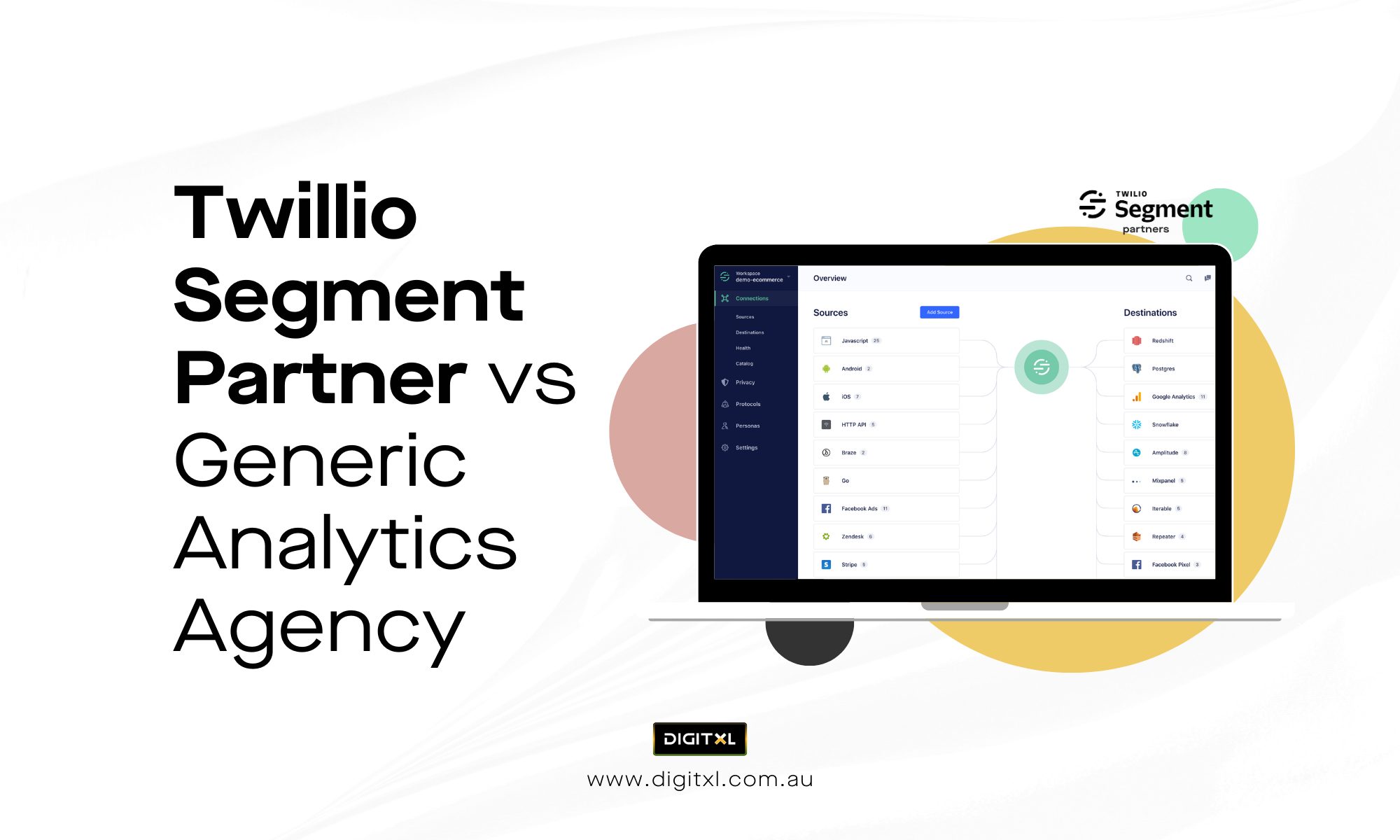
A Segment-focused team sees the Twillio Segment tool as the central switchboard for your customer data. Everything else – Facebook Ads, Klaviyo, HubSpot, your data warehouse – plugs into that layer. Their mindset is:
- “Track once, send everywhere.”
- “Define events and identities centrally.”
- “Avoid re-implementing the same logic in every tool.”
A general analytics agency is usually tool-agnostic. They’ll work with whatever you already have installed. That flexibility is handy, but it can also mean:
- Tracking is duplicated across tags and tools
- Business logic is scattered in multiple platforms
- Changes are harder to govern because nothing is central
If your main challenge is “we just need better reports”, a generalist is often fine. If your challenge is “our data is fragmented and hard to trust”, platform specialists tend to be a better starting point.
4. Implementation Depth and Engineering Involvement
A specialist delivering Twillio Segment services will typically:
- Work closely with your developers to design event payloads
- Decide what should be tracked client-side vs server-side
- Handle replay, batching and destination-specific quirks
- Document schemas so future teams know what’s what
They think in terms of schemas, queues and APIs as much as they think about dashboards and campaigns.
By contrast, many general analytics teams are strongest at:
- Designing measurement frameworks
- Mapping user journeys to events and goals
- Standing up dashboards and basic tagging
- Training marketers and product owners to self-serve reports
If you need real engineering involvement around data collection and routing, an infrastructure-minded team is hard to replace.
5. Strategy: Activation vs Insight
Both partner types will talk about “driving growth”, but they usually enter the picture at different points in the journey:
- A generic analytics agency focuses on insight – “what is happening and why?”
- A Segment-focused team leans into activation – “how do we get the right data into the right tools so teams can act on it?”
That’s why many brands use both:
- An analytics agency for GA4, BI and reporting
- A Segment specialist for event design, identities and downstream activation
In that setup, Twillio Segment consulting shapes the data foundation, while the analytics agency helps your teams read and act on what flows out of it.
Once reliable customer data is flowing into analytics, CRM and marketing platforms, a CRO consultant can use those behavioural and audience signals to identify where users hesitate and which experiences should be tested. This helps connect Segment’s data foundation with practical improvements to landing pages, forms, personalisation and conversion journeys.
6. Governance, Compliance and Long-Term Maintenance
A big advantage of working with a structured Twillio Segment consultancy is how they think about the future:
- Versioning and deprecating events
- Handling consent and regional rules
- Onboarding new tools without redoing tracking
- Avoiding “schema sprawl” as more teams request events
Generic agencies can certainly contribute here, but many engagements are scoped as one-off implementations or dashboard builds. Unless governance is explicitly part of the brief, it’s easy for your tracking to drift over time.
If you already feel like “no one really knows what’s tracked where”, governance support is a strong reason to bring in a Segment specialist.
7. When a Generic Analytics Agency Is Enough
There are still plenty of cases where a generalist is the right call:
- You’re early-stage and mainly need GA4 and a few core dashboards
- Most of your decisions can be made on web analytics plus ad platform data
- You’re not yet investing heavily in email, personalisation or multi-channel journeys
- Your tech stack is relatively simple and you don’t have a warehouse in place
In those situations, a CDP might be overkill – and a good analytics partner can give you plenty of value without introducing new platforms.
8. When a Twilio Segment Partner Is the Better Fit
You’re more likely to benefit from a dedicated Twillio Segment agency when:
- You have multiple tools all collecting their own data (ads, email, CRM, product analytics)
- You’re moving towards identity-based journeys and personalisation
- You want a clean, governed way to send events to many destinations
- You’re investing in a warehouse and want consistent data models downstream
In that context, treating Segment as part of your core data infrastructure – not just another tag – gives you more control and flexibility as the stack grows.
9. Blending Both Types of Partners
Many mature teams end up with a hybrid:
- Segment specialists for implementation, schema design and governance
- Analytics partners for GA4, BI and stakeholder-facing reporting
- Internal teams who own product decisions, campaigns and experimentation
For Sydney-based organisations, working with a CRO agency in Sydney can add a structured experimentation layer to this partner model. Segment specialists can maintain the customer data foundation, analytics teams can provide reporting, and CRO specialists can turn those insights into prioritised tests across important digital journeys.
In this setup, Twillio Segment consulting is the bridge between raw events and the tools that marketing, product and data teams use every day.
10. How to Decide What You Need Right Now
A simple way to choose:
- If your main frustration is “we can’t see performance clearly” → start with reporting and general analytics support.
- If your main frustration is “our data is inconsistent and scattered across tools” → start with Segment and customer data infrastructure.
- If you feel both pains → consider a joint approach, where a Segment-focused partner and an analytics team collaborate on a shared roadmap.
Getting this mix right matters. The aim isn’t to collect more data for the sake of it – it’s to give your teams reliable, shared information they can act on without constant firefighting.

 Previous